
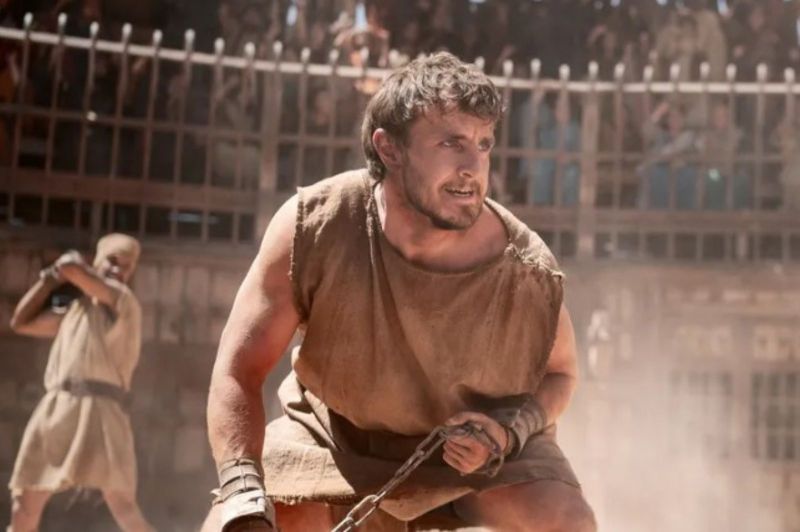
Historical/period/epic

Film review, by Jason Day, of Gladiator II (2024), director Ridley Scott’s sequel to his Oscar-winning 2000 epic. Paul Mescal takes the lead from Russell Crowe in a less than auspicious return to the Roman Empire and the battling gladiators of the coliseum.
Synopsis
Years after the death Roman soldier Maximus Decimus Meridius (Russell Crowe) – forced into gladiatorial slavery – Lucius, his son by Lucilla (Connie Nielsen) and rightful heir to the Imperial throne, has been living in hiding among other gladiators.
Now a grown man and fearless fighter himself (Paul Mescal), Lucius returns to Rome to avenge the death of his female soldier partner and topple the corrupt regime of the debauched, deranged brothers and co-Emperors Geta (Joseph Quinn) and Caracalla (Fred Hechinger).
Review, by @Reelreviewer
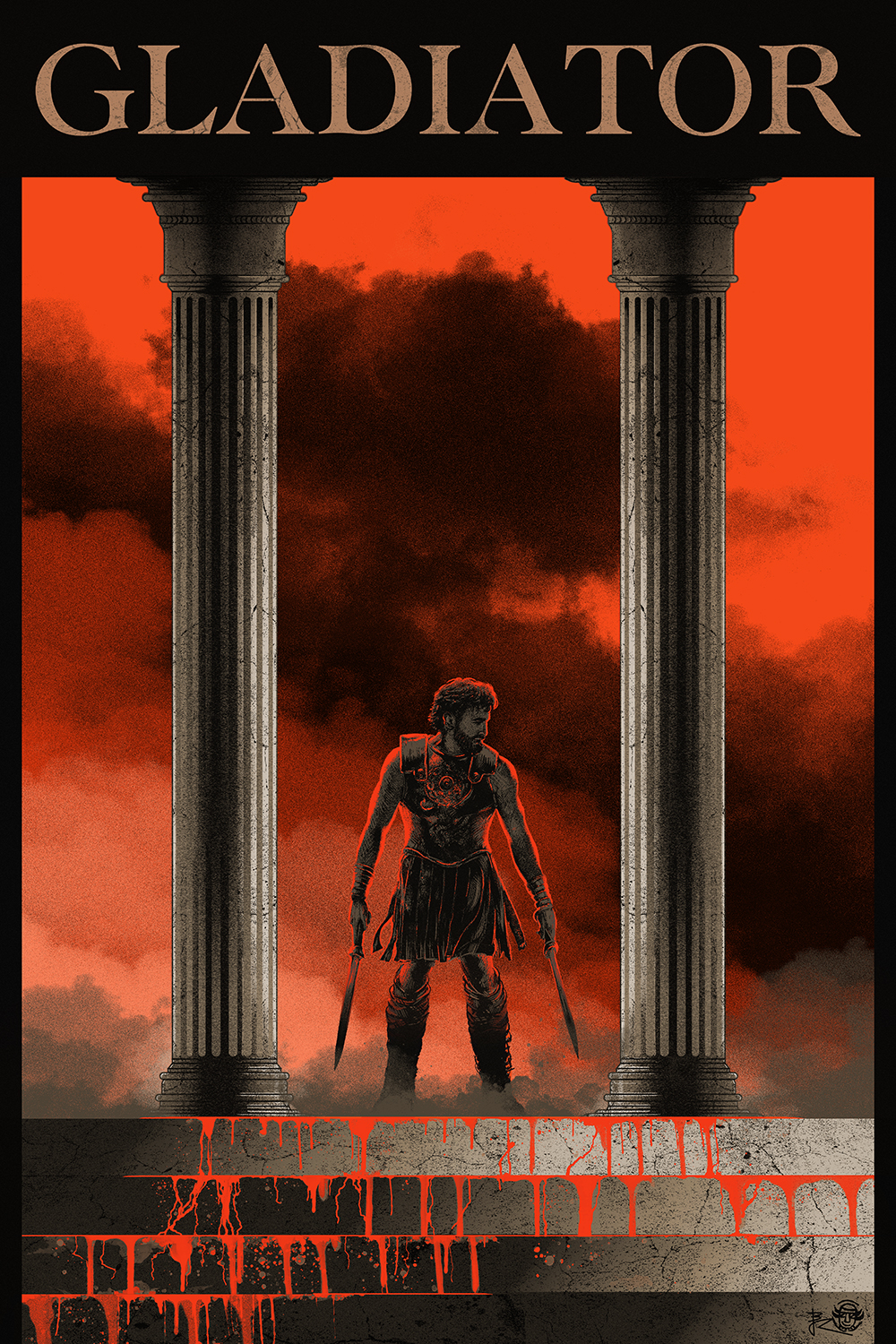
Ridley Scott is a fella felicitous for fighting.
A former ad man (one of the commercials he directed is the iconic ‘bike round’ for Hovis Bread, where the young lad tries to cycle up a mighty hill to complete a bread delivery), he has helmed motion pictures since 1977’s The Duelists. In that film, Harvey Keitel and Keith Carradine play Napoleonic soldiers whose minor argument leads to 15 years of duelling against the backdrop of ever-changing European militaristic politics.
Fighting and violence have punctuated Scott’s films since then. The xenomorph of Alien (1979) has an instinctual desire to wipe out the human spaceship crew, Bladerunner (1982) features multiple hyper-stylised fight scenes, the neo-noir, nihilistic cop thriller Black Rain (1989), and even the uneven Hannibal (2001) that leans toward sociopathic, cannibalistic aggression and person-destruction. Almost all of his productions stage some form of fisticuffs, so he was the right director to resurrect the gladiatorial/ancient era epic.
And Gladiator (2000) certainly did that. A sort of remake of Anthony Mann’s The Fall of the Roman Empire (1964) – which, ironically, killed off this subgenre of films when it colossally flopped at the box office – Russell Crowe took on Stephen Boyd’s old role, and magnificently so.
Crowe turned in a very masculine, thoughtful, patient turn, helped by a blessedly poetic script. He won Best Actor at the Oscars and the writing was also nominated.
With this sequel, Scott returns to the same place, time and people a couple of decades or so after where the original film left off, a cinematically difficult move to make. As a director, his new movie needs not only to pay suitable homage to the original, it also needs to top it and not just in spectacle (the easy thing to surpass), but in every other way.
Few directors in the post-DeMillian movie world can helm a full-on, in-your-face, stomping action epic than Ridley Scott, as he has proven time and time again. Sadly, his Gladiator sequel misses the mark with regurgitation and repetition. For those of you who haven’t seen the first movie – and I suggest you do – the following comments will make no sense (a point in itself – why not ignore the original and skip to the update? That would be a mistake in my eyes).
The beauty and visual symbolism that marked out the 2001 movie as contemplative and intelligent Crowe scooping up grains and sand from the ground to ‘centre’ himself, his dreams of his beloved wife – are copied and pasted here, reducing the meaning to a cheap repetition.
Some of the first film’s cast return to the same roles – Nielson, Derek Jacobi as Gracchus – but they are, shamefully, relegated almost to background scenery with little to do on screen. Instead, new cast members step into the spotlight with terrible results. Mescal, Denzel Washington and Pedro Pascal are talented actors but are hanged out to dry with poorly written characters and unfocused direction, almost as if they were expected to slot into the script and get on with things.
Mescal, whom I loved in TV’s Normal People and the enthralling gay love story All of Us Strangers (2023), has slipped in my estimations. From a brooding, moody, saturnine Heathcliff-type he is now painfully out of his depth here. He has Russell Crowe’s moves and is competent with the fight scenes, but when he reaches for the stirring speeches of his cinematic pappa, he whimpers in comparison. It says much more of the acting of the gladiatorial extras his character commands that they appear nudged to do something.
As an aside – I’m sure historians will be able to counter this point – but I still don’t get how Mescal’s character, the son of the Roman Imperial family, has been secreted away to the desert for his safety for years to be brought up to be a gladiator. These royal children are rarified and guarded beyond belief to ensure dynastic succession – so why wasn’t he dropped in a nice, suburban house on the coast in an out-of-the-way province somewhere?
Although the music is a dud – more economical than epic – there are lots of technical whoops. The cinematography, costuming, hair/make-up, stunt work and production design, although I’m not the only reviewer left scratching my head at the water battle with sharks in the Coliseum.
There’s stuff to like in Gladiator II, but it’s too stuck in the shadow of its predecessor to emerge as a thrilling film in its own right.
See the official, Paramount Pictures trailer.
Cast & credits
Director: Ridley Scott. 2hrs 28mins/148 mins. Scott Free Productions/Red Wagon Entertainment/Paramount Pictures. (15).
Producers: Lucy Fisher, David Franzoni, Michael Pruss, Ridley Scott, Douglas Wick.
Writer: David Scarpa.
Camera: John Mathieson.
Music: Harry Gregson-Williams.
Sets: Arthur Max.
Paul Mescal, Denzel Washington, Pedro Pascal, Connie Nielsen, Joseph Quinn, Fred Hechinger, Lior Raz, Derek Jacobi, Peter Mensah, Matt Lucas, Alexander Karim, Yuval Gonen, Richard McCabe, Tim McInnerny.
 CineSocialUK