
Romance

Film review of The Garden of Allah, the 1936 technicolour movie starring Marlene Dieterich as a former convent girl in love with mysterious Charles Boyer. Directed by Richard Boleslawski.
Synopsis
After leaving the supportive confines of her childhood convent, young Domini Enfilden (Marlene Dietrich) is troubled about what to do next. She follows advice to find her destiny in the Sahara Desert and travels there, perturbed by the presence of the handsome but mysterious fellow traveler Boris (Charles Boyer).
Review, by @Reelreviewer

A man who fears to acknowledge his god is unwise to set foot in the desert. The Arabs have a saying, madam. The desert is the garden of Allah.
I have only once dipped into the Sahara area, having travelled to Morocco – Marrakech and Essaouira – for a week some years ago.
OK, so it isn’t exactly the desert, but it’s close enough, and it was mostly an amazing experience.
We stayed in a souk, and it was a good one, too. It was comfy and my friend and I were the only guests, so we were waited on hand on foot. We enjoyed the markets, saw the King’s Palace, ate loads of beef and lamb tagine (quite refreshing even though the food was piping hot and it was roasting outdoors), and spent the day on the road to spend a few hours on the beach.
I’ll leave aside the tense day where we stupidly ventured off the tourist route, but I did have a ‘Marlene moment’ with my shirts and shorts flapping in the breeze. Lips a quiver and mouthing some of the stodgy dialogue from her first color movie, The Garden of Allah, I felt every millimetre a movie star (sort of).
This overegged technicolour trifle is based on the novel by Robert Hichens, previously successfully adapted for the (silent) screen in 1927 with Alice Terry and Ivan Petrovich.
With its penchant for swooning characters and overheated, implausible events, the silent screen was the perfect environment for something as dippy but visually stunning as The Garden of Allah. This explains why this sound version (the only one so far) falls flat on its cinematic face.
The story’s cod religiosity, so quaint on silent movie title cards, sounds clunky and hackneyed in a sound movie. Something that appeared ‘mythical and mysterious’, like a mother superior suggesting her favourite charge travel to a harsh landscape, here appears like ecclesiastical torture.
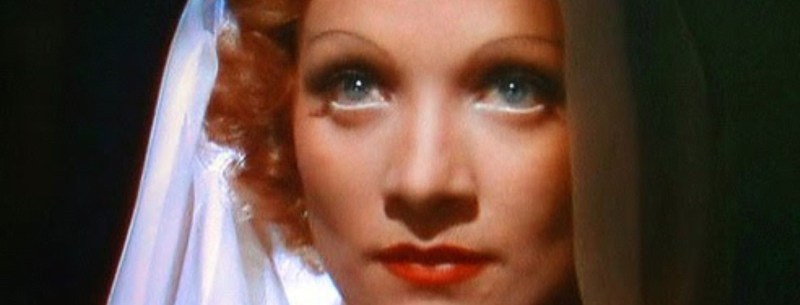
When we first meet her, Dietrich’s character’s father has just died, a man who was as religious as they come and, it’s implied, held her in a tight, overly protective grasp. Now, papa has shuffled off his mortal coil, but Dietrich emerges looking like a porcelain doll trying to be a high-class hooker.
The make-up is plastered on her, and with hair dyed to look like spun gold and pencilled in, high arch eyebrows, it makes you wonder how ‘chaste’ and demure this religious woman is.
At least those long lashes will keep the sand out of her eyes.
She’s kitted herself out superbly with increasingly ridiculous (but gorgeous), diaphanous garments that look like she’s perma-ready for a first night.
The wardrobe matches Dietrich’s annoyingly ‘heavenly to the max’ performance – whispering voice and wan expressions – preposterous. She’s not helped by the awful, wooden script that gives her (and everyone else) a tome of clichéd platitudes and proverbs to vocalise.
Dietrich’s ‘tarty trousseau’ attracts the attentions of Batouch, a fabulously priapic guide played with ‘nudge, nudge, wink, wink’ delight by Joseph Schildkraut and the supporting cast is filled with character actors who just about persuade you this silliness tolerable (Rathbone as a handsome count, John Carradine as a diviner of the sand and Tilly Losch who performs an extraordinary, half sexy, half ‘wtf?’ dance as Schildkraut’s posessive girledfriend).
As Dietrich’s leading man, Charles Boyer – the thinking, 30s cinema-going woman’s crumpet – is also off-key. He’s given little to say, and even though his character is in two minds about his destiny, he plays up the vacant stares and pauses in his delivery.
Perhaps this uneven approach is down to off-camera troubles. Filming in the Arizona and California deserts, already complicated, was made more challenging due to the requirements of the new (and very pretty) three-strip technicolour (this was one of the first movies to be completed using that process).
Cast & credits
Director: Richard Boleslawski. 79mins/1hr 19mins. (Selznick International Pictures/United Artists. (U).
Producer: David O’Selznick.
Writers: W.P. Lipscomb, Lynn Riggs.
Camera: W. Howard Greene, Virgil Miller, Harold Rosson.
Music: Max Steiner.
Sets: Lyle R. Wheeler.
Marlene Dietrich, Charles Boyer, Basil Rathbone, Joseph Schildkraut, Alan Young, C. Aubrey Smith, Tilly Losch, John Carradine, Lucille Watson.
 CineSocialUK