
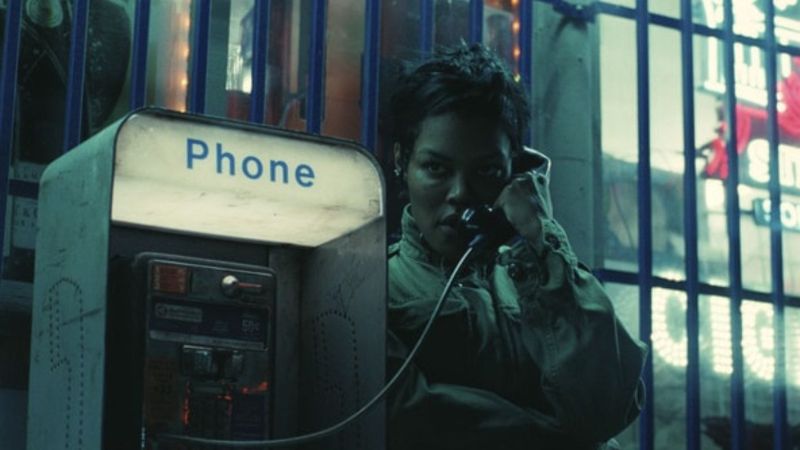
Movie review of the politically-charged action drama from director Paul Thomas Anderson about left-wing insurrectionists. Starring Lenoardo di Caprio and Sean Penn.

Synopsis
From IMDb.com: ‘When their enemy resurfaces after 16 years, a group of ex-revolutionaries reunite to rescue the daughter of one of their own.’
Review, by @Reelreviewer
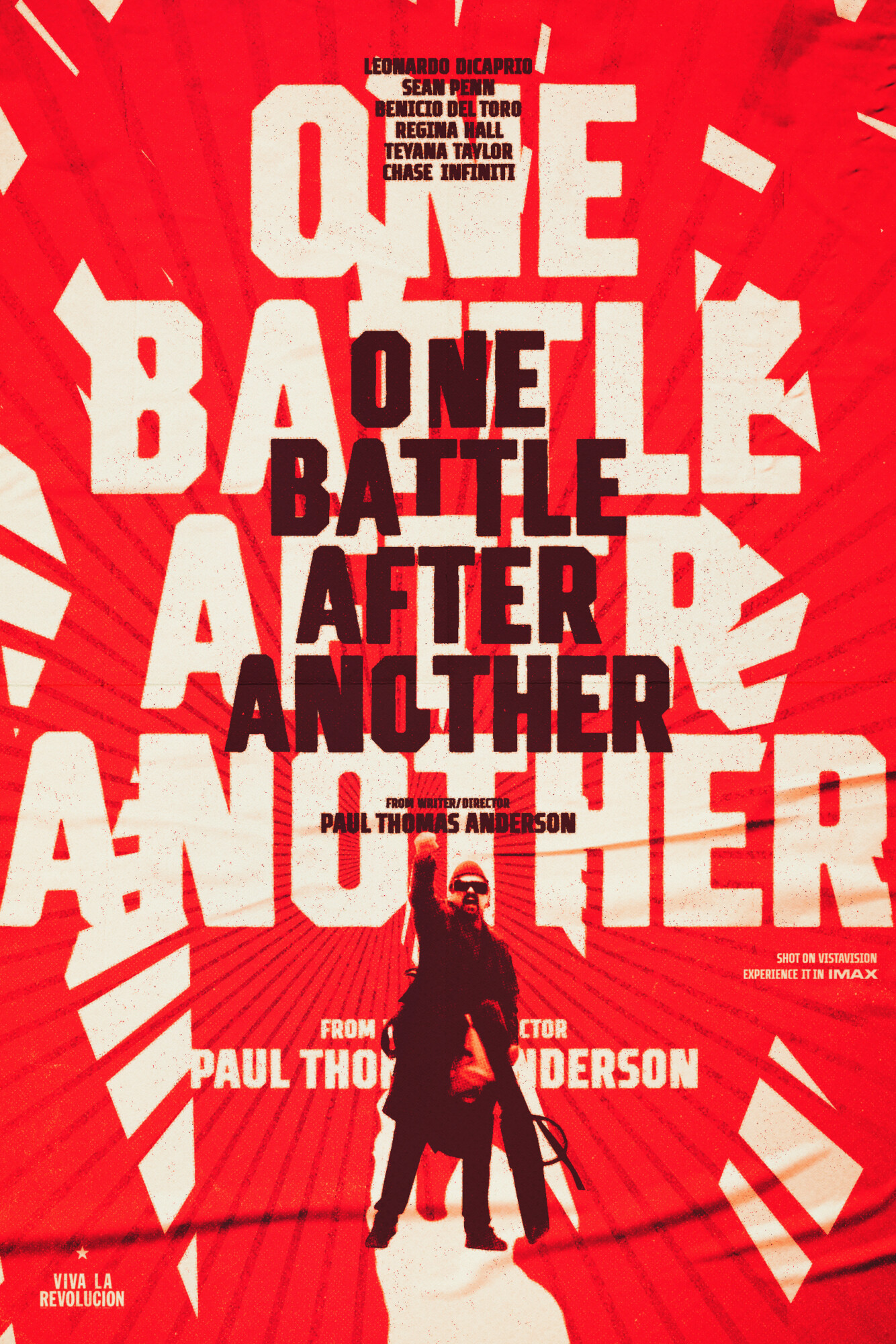
One Battle After Another (2025). Poster by Augustin R Michel. X: @AgustinrMichel Insta: agustinrmichel
The quote above is the opening line of this film, a bold and attention-grabbing start in a noisy, political piece and one where “pussy” has multiple meanings.
To anyone who says Hollywood doesn’t ‘do’ up-to-the-minute political films, that they take too long to develop, produce, promote and distribute to be politically current, tell them to watch One Battle After Another.
When one accepts and is comfortable with the fact that all movies have a political slant and that everything in a movie – from the words on the script, how much money is poured into it and where that money goes, to what is edited in and what is chucked on the cutting room floor – happens for a planned and justified reason, you can watch One Battle After Another and then settle down to have a good talk about what you saw and heard and why it all happened that way.
I’ll be frank from the outset, as admirable as elements of this movie are – the acting is peerless throughout, for instance – I did not enjoy this movie. Perhaps it is not meant to be entertaining, but with upwards of $200 million in box office takings as of late February 2026, many people are turning out to see it.
Outside the comforting black of the cinema, left-wing insurrectionism is practically a fashion item in society now. You can imagine the latest Antifa antics and Pro-Palestinian prattling picked apart at the swanky West End dinner parties of the privileged, but acts of criminality, murder and terrorism presented as ‘du rigeur’ – at those parties and on the silver screen – leave a sour taste in my mouth.
One thing that Paul Thomas Anderson (Boogie Nights, 1997; Magnolia, 1999; The Master, 2012) certainly knows how to do is squeeze a damn good performance out of his actors.
The women are mostly the catalysts of action and change, so no surprise their performances are strides ahead of their male counterparts, barring Sean Penn, whom I’ll come to in a moment.
As Perfidia, a woman so committed to the causes of violent left-wing insurrectionism that she abandons her baby, and later, witness protection in the admittedly dull, quiet grey of suburbia, Teyana Taylor bags what could be the role of a lifetime. A lesser actor might have struggled to bring out the human elements of a complex character, but Taylor balances the extremes of aggressor and mother just right, going full throttle with the former and a nice cruise control with the latter.
Regina Hall – mostly known for role as the perpetually resurrected Brenda in the Scary Movie franchise – is a surprise and welcome addition in a dramatic role as one of the decidedly unconventional ‘nuns’ who take Willa in. This key moment is when Willa learns more about her past and her mother.
Sean Penn, on the other hand, as the clearly deranged, old school bigot fetishistically obsessed with black women, once, he is stirred to erection and ‘captured’ which fits nicely with his stiff army walk – Col. Steven J. Lockjaw, appears to have strutted in from another film or TV set. That production could possibly be a comedy with a vaguely militaristic theme – ‘Lockjaw’s Luddites’, if you will.
DiCaprio – the doyen for first-class directors wanting a strong male lead – is nonetheless rendered passive, almost paralysed emotionally, within Anderson’s racially slanted epic. There is one scene where, in Benicio del Toro’s apartment, he engages in a charged and aggressive phone call with ‘Joshua’ (just like those in Scorsese’s The Wolf of Wall Street (2013) and you see that flash of superb performance he regularly provides.
In this film, he’s a tremulous terrorist but Anderson’s focus is not on his white male characters, who are either husbandly doormats left holding the baby – DiCaprio’s character berates himself at one point, about his fatherly skills, with “I don’t know how to do her hair right”, a bizarre claim when he raised her single-handedly for nearly 20 years – coldly calculating white supremacists hunkered in a bunker or insane, sexually predatory psychopaths like Penn.
Aside from all the above, the scenes with Penn are where I most struggle with One Battle After Another. They’re incredible, jaw-dropping moments, but when I first saw trailers for the movie on Instagram, with reels posted of scenes featuring Penn. To me, it looked like a bizarre, completely off-the-wall comedy…or was it a satire?
Is it a satire that operates on such a high level that its messages went way above my teeny-tiny head (it’s up for 13 Oscars plus multiple other awards… and it’s not like I haven’t been wrong before)? The film, at its more intimate moment, is of course about family and loyalty, whether personal or politicial, but the line between drama and weird comedy in this movie is thin and frequently crossed.
See the official Warner Bros. UK trailer.
Cast & credits
Director: Paul Thomas Anderson.
Producers: Paul Thomas Anderson, Sara Murphy, Adam Somner.
Writers: Paul Thomas Anderson, Thomas Pynchon.
Camera: Michael Bauman.
Music: Jonny Greenwood.
Sets: Florencia Martin.
Leonardo DiCaprio, Sean Penn, Benicio Del Toro, Teyana Taylor, Regina Hall, Chase Infiniti, Wood Harris, Alana Haim, Paul Grinstad, Shayna McHayle, Tony Goldwyn, John Hoogenakker, Starletta DuPois, Eric Schweig.
 CineSocialUK