And the Oscar could go to…

Standard

Difficult to judge where the little tin/copper, gold plated men will go to this year as many of the contenders for awards (Lincoln, Zero Dark Thirty, Django Unchained, The Sessions) are yet to be released in the UK.

The next 3 weeks should see to that, so I will revisit this initial assessment but, based on what I’ve seen and Oscar’s own personal tastes, this is what I predict right now will win in the main four categories:


Best Picture – Lincoln. Friends in America have been none to impressed by this judging it to be long and dull, but the critics seem happy and it’s not as if a big Civil War epic hasn’t cleaned up before (ahem, Gone With the Wind).

Best Director – Steven Spielberg for Lincoln. It usually follows that the Best Director made the Best Picture. None of the other nominations, with the possible exception of Benh Zeitlin for the acclaimed Beasts of the Southern Wild would, in my mind, stand much of a chance. The other films are good, but Lincoln has that old style craftsmanship and tells a good political/moral that could tickle older Academy voters (according to this incisive investigation by the LA Times , the average age is 62) and see it through.

Best Actor – Joaquin Phoenix for The Master. This was a stunning turn. As much as I think Daniel Day-Lewis deserves it for Lincoln (and on the basis of the trailer, his performance is just as extraordinary), Phoenix is a revelation as the physical personification of a tortured, confused soul. Definitely not Hugh Jackman (Les Mis is a musical and musicals don’t usually win for the lead actor roles).

Best Actress – difficult one to call as the actresses here are all great. Oscar could be sentimental and give it to their oldest Best Actress nominee Emanuelle Riva for Amour but, Marion Cotillard aside as an anomaly French actress winning for speaking French in a French film, my money would be on Naomi Watts in The Impossible (tragedy, human interest – Oscar can still be sentimental).


Awards season kicks off – BAFTA Film nominations announced

Standard

Steven Spielberg’s yet to be released in the UK American Civil War biopic Lincoln leads the way at this year’s BAFTA Film awards with 10 nominations. The full list of nominees can be read on BAFTA’s site here.

And for the Oscars – stay tuned for tomorrow’s announcement.

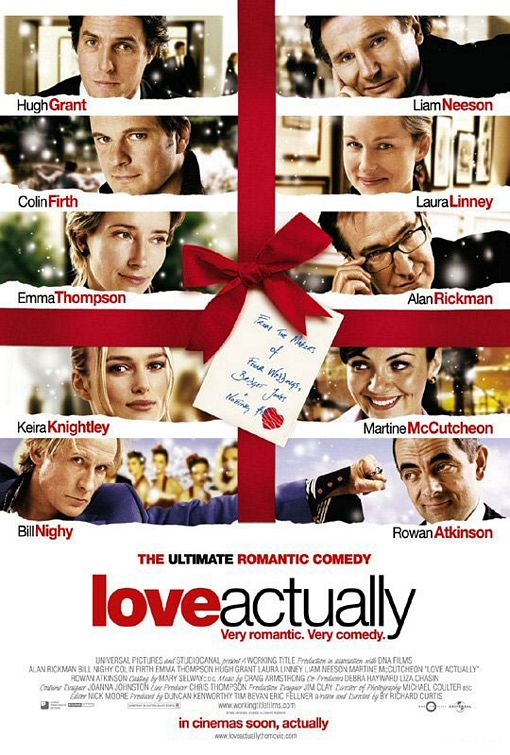
Love Actually (2003)

Standard

Director: Richard Curtis. Universal/Studio Canal/Working Title/DNA Films. (15).

COMEDY


Producers:
Tim Bevan, Eric Fellner, Duncan Kenworthy.
Writer: Richard Curtis.
Camera: Michael Coulter.
Music: Craig Armstrong.
Sets: Jim Clay.

Hugh Grant, Liam Neeson, Colin Firth, Laura Linney, Emma Thompson, Alan Rickman, Keira Knightley, Martine McCutcheon, Bill Nighy, Rowan Atkinson, Gregor Fisher, Chiwetel Ejiofor, Andrew Lincoln, Kris Marshall, Martin Freeman, Joanna Page, Sienna Guillory, Rodrigo Santoro, Edward Hardwicke, Billy Bob Thornton, January Jones, Claudia Schiffer, Shannon Elizabeth, Denise Richards.

SYNOPSIS

The love lives of eight very different couples in London are chronicled in the run up to Christmas.

REVIEW

Largely successful, Brit-portmanteau picture that could have been titled Luvvies Actually given how much of Equity’s register has been emptied to fatten up the cast list.

Right at the top of the bill (and that has never been an indication of quality in such star-studded pictures) is Grant as a love-lorn and single Prime Minister chasing clumsy new tea-girl McCutcheon. This is a gormless and charmless pairing, Grant’s aggravating, stuttering bluster by now a cliche, a cinematic short-cut of performance. McCutcheon is a chirpy ‘cockernee’ sparra’. Well, what else would she be? Her post- Eastenders debut was never going to push expectations.

Such ego-heavy productions groan at the seams with performers ecstatically trying to out act each other. Oddly though, the turns that stick in the memory here are those that don’t try too hard. Neeson trying it on with thinly veiled supermodel Schiffer (ignore the awful child crowing them on), Rickman contemplates a mid-life affair encouraged by nice friend Thompson and there is a heartbreaking threesome in Knightley, Ejiofor and Lincoln. The denouement to this particular thread of the story is literally a wrench, brilliantly and shockingly delivered by these actors.

There are still more powerful turns. In terms of comedy, Nighy and Fisher score most strongly in the entire film. They feature as a washed up eighties pop star and his long-suffering manager, trapped forever in a sexually unfulfilling bromance. Nighy is given one last shot at music immortality with a fairly ropey Christmas single. There can be no greater satisfaction for a cynical British audience, in this part of the story at least, to hear him refer (to Fisher’s horror) to Ant and Dec as “Ant or Dec” and note to their audience of largely under 15 year olds: “Kids, don’t buy drugs. Become a rock star and people will buy them for you”. This has to be the best line that Curtis has ever dropped into a motion picture screenplay. Thank you Richard!

For drama though, take a bow Ms Linney. One of the handful of visiting foreigners in this film, she can hold her head up high that, on celluloid at least, she juggles a difficult storyline perfectly as a woman trying to placate a mentally unbalanced brother and maintain the interest of horny Brazilian colleague Santoro. She deserves an Oscar for managing to keep her hands off him. This is the most impressive straight performance in the whole film.

Atkinson, who shares Curtis’ love of the extended similie and that certain Oxbridge humour (they both worked together on the Blackadder TV series) ties elements of the movie together as an obsequious Department Store sales clerk in some ill advised pantomime, but the film still scores because the humour and feel-good factor are nicely balanced with believable festive angst.

Home Alone (1990)

Standard

Director: Chris Columbus. 20th Century Fox/Hughes Entertainment. (PG).

COMEDY


Producer:
John Hughes.
Writer: John Hughes.
Camera: Julio Macat.
Music: John Williams.
Sets: Dan Webster.

Macaulay Culkin, Joe Pesci, Daniel Stern, John Heard, Roberts Blossom, Catherine O’Hara, John Candy, Angela Goethals, Devin Ratray, Gerry Bamman, Kieran Culkin.

SYNOPSIS

Precocious 8 year old Kevin (Culkin) is accidentally left at home on his own during his family’s last minute rush to the airport for a Christmas break in Paris. As he struggles to fend for himself, two inept burglars (Pesci, Stern) attempt to break into his house. Ready for when they return, he sets a series of traps to protect his home.

REVIEW

A film that clearly puts into perspective what the true meaning of Christmas is: cute little kids burning other humans, smashing paint cans over their heads and generally hospitalising them in some indescribably cruel, but at the same time ‘hilarious’ manner. Ho! Ho! Ho! For ’tis the season to call social services?

Culkin went, very quickly, from being the most famous person on the planet to being almost persona non grata as possibly the most annoying child in the world. Despite showing resourceful charm and the cheeky resilience that made Jackies Coogan & Cooper and Shirley Temple into worldwide stars, he also shows the tipping point at which children in movies went from wide-eyed intelligence to smug, self-aggrandising know-it-alls.

Writer/Producer Hughes gave the world the ‘Brat Pack’ in the eighties so Culkin was his gift for the next movie generation (Thanks Unlce John!). He sits squarely away from the director’s chair on this occasion, handing over the reigns to Columbus, but his style is imprinted on every frame: kids in control, children as resourceful people, parents sidelined, broad slapstick comedy.

By this time the prolific Hughes, whose films had defined a decade, was receding more and more from public view (his last film as a director was the lamentable Curly Sue in 1991) but he could still churn out blockbuster hits, which Home Alone went on to become, incredibly spawning 4 sequels.

What Hughes was always a genius at doing was reducing his writing to the worldview of a child without ever patronising his key audience. Home Alone is probably the most grown up film for very young children he ever made, if you consider how uniquely independent Culkin’s character is, the intellectual and physical power he wields over the burglars trying to break in and the free reign he has over a dominion that is usually the sole preserve of the parent – the house. I can clearly remember, aged 11 when the film was first released, how completely jealous I (and a few of my classmates) were to see a peer fending for himself, fighting of the baddies and having a blast in the process.

It helps that what Hughes does is never once let us forget that the lengths Culkin’s character goes to to protect his home and possessions are only half believable. Exaggerated antics, but still rooted in the reality of what a child with very little concept of what pain is could do to someone with everyday household objects and a vicious imagination. That the ‘comedy’ in this slapstick house of horrors works is due in no small part to the fantastic orchestration by Columbus, the screenwriter of Gremlins (1984), who clearly was making a career at causing ultimate mayhem at Christmas. Columbus ensures that the ingenuity of Kevin’s revenge is never once ridiculous.

The other side of the coin that makes these sequences so guiltily enjoyable is in the playing of the villains by Pesci and Stern. These two deal admirably with the punishment meted out to them. Pesci would win the Best Supporting Actor Oscar for his work this year, but for a very different role in a markedly different movie, as the unhinged, unpredictable and foul-mouthed Tommy DeVito in Scorsese’s gangster epic Goodfellas.


It’s a Wonderful Life (1946)

Standard

Director: Frank Capra. Liberty Films/RKO (U).

DRAMA


Producer:
Frank Capra
Writers: Frances Goodrich, Albert Hackett, Frank Capra.
Camera: Joseph Biroc, Joseph Walker, Victor Milner.
Music: Dimitri Tiomkin.
Sets: Jack Okey.

James Stewart, Donna Reed, Lionel Barrymore, Thomas Mitchell, Henry Travers, Beulah Bondi, Frank Faylen, Ward Bond, Gloria Graham, H.B. Warner, Frank Albertson.

SYNOPSIS

George Bailey (Stewart) is a nice, compassionate guy. But one Christmas, the stresses of work and life get the better of him and he considers committing suicide. An angel-in-training (Travers), needing to gain his ‘wings’, visits him and shows him how poor life would have been for his family and local community if he had never existed.

REVIEW

Boo! Hiss! To the critic who dares to give this perennial American film favourite anything less than 5/5. But, in all honesty, you would have to be American to completely ‘get’ the whimsical schmaltz that pervades every frame of Capra’s lovingly remembered movie, loosely inspired by Dickens’ A Christmas Carol.

Not that it was so lovingly received at the time. It’s a Wonderful Life only broke even at the box office, though it’s high production costs probably added to it’s financial woes. Confidence in Capra as a director of high quality, populist, star-studded morality tales was so shaken after this he directed only five more films.

Whether you find the sweetness of the finished product endearingly nostalgic or pancreas-busting depends on one’s viewpoint, but there is enough subversion within the storyline to warm the cockles of any humbugs heart.

The downbeat opening, with Stewart’s stress-levels palpably revealed on the screen in all their nervous-eyed twitchiness, are quite stark, especially when compared with the almost evangelically upbeat tone that builds as the film progresses.

There are further impressively ‘negative’ performances from Graham as the peroxide blonde town tramp and Barrymore in perhaps his most remembered (probably not so fondly) as Potter, the true spirit of American miserliness, the town’s fat cat determined to take over and close down Stewart’s company. Barrymore read Dickens’ Carol on the radio and that lead to his casting in this film.

There’s no denying Capra’s skill in making this kind of halyconic, praise be to the family and man film. The result is seductive, perfectly paced, beautifully filmed and, as befits the title, full of wonderful moments. But from a modern sociological, psychologically-slanted perspective it is difficult to relate to his almost simplistic reasoning that a dutiful, placid wife and cute kids decorating the Christmas tree are all that a man needs to sort himself out. Extrapolating this further, society can’t be righted simply by people being nicer to each other, wonderful an idea that is in itself. It’s only as the film progresses that this vein of hyper-jingoism becomes more pronounced – the perfect antidote to festive season arguments at home perhaps, but ultimately aggravating.

Die Hard (1988)

Standard

Film review of the action film starring Bruce Willis about a group of European terrorists who take over a Los Angeles skyscraper during a Christmas party.

To like this review, comment on it or to follow this blog, scroll to the bottom of the page. Use the search function on the left of the screen to look up other reviews.

Director: John McTiernan. Twentieth Century Fox/Gordon/Silver. (15)

ACTION/ADVENTURE/FANTASY


Continue reading

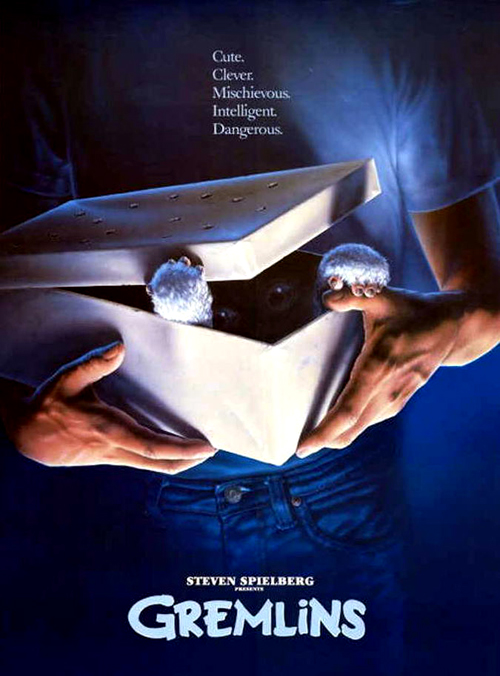
Gremlins (1984)

Standard

Director: Joe Dante. Warner Bros./Amblin (12a)

COMEDY


Producers: Michael Finnell. Writer: Chris Columbus. Camera: John Hora. Music: Jerry Goldsmith. Sets: James H. Spencer.

Hoyt Axton, Zach Galligan, Phoebe Cates, Corey Feldman, Dick Miller, Frances Lee McCain, Judge Reinhold, Harry Carey Jnr., Jackie Joseph, Polly Holliday, Keye Luke.

SYNOPSIS

One Christmas, third rate inventor Randall Peltzer (Axton) stumbles upon a Chinese curiosity shop staffed by the mysterious Mr Wing (Luke). Despite Mr Wing’s initial refusal, Peltzer pesters him for the Mogwai in his shop, a cute, furry creature that sings adorably. Eventually, Wing acquiesces but only if Peltzer can adhere to three important conditions: that he never exposes the Mogwai to sunlight, never feeds him past midnight and never, ever lets him get wet. Peltzer agrees and returns home to give the Mogwai, called Gizmo, to his excited son (Gallagher). Chaos reigns, however, when Gallagher accidentally breaks every one of the rules. The town of Kingston Falls will never be the same again.

REVIEW

Writer Columbus clearly enjoys causing mayhem during the festive season. He would later direct the comedy Home Alone in which a little boy almost kills two inept burglars who are trying to rob his home. His two Harry Potter movies saw plenty of sorcery amidst the snow flakes. Here he first displays his talent for creating utter chaos at Christmas in this sly horror update of Frank Capra’s It’s a Wonderful Life.

Galligan is the James Stewart character who, whilst not contemplating suicide, is a depressed lad from a poor family, stuck in a dead-end job as a bank clerk, with a horrible rich customer (Holliday) who wants to kill his scruffy dog and a boorish boss (Reinhold) who is constantly breathing down his neck and trying to bed his sweet, Donna Reed-esque girlfriend (Cates).

So far, so anodyne, and the film dawdles along at a warm and welcome pace, but Columbus is only interested in showing us this torpid side of Main Street Americana as the sweetest of back drops to the main action when the now ubiquitous, rabid title monsters spawn from the most adorable and innocent of creatures to signal the little town’s veritable death knell in a one night only riotous orgy of comic cruelty, destruction, drunkenness and violence.

Credit where it’s due, Columbus and Dante really know how to let rip when the Gremlins appear. Nothing is off limits here and director pushes the writer’s imagination: dogs are strung up with Christmas lights, bars are drunk dry and trashed like in the Wild West, vicious old ladies are sent careering into a crisp moonlit sky when their stair lifts are hot-wired, houses are trashed with JCB’s and sweet little housewives are forced into knife wielding frenzies of anger that end with death by microwave and blender.

Axton’s shaggy charm and patience as the ultimate in good guys who, while they may have failed most of their duties in life have managed to be a good parent and provide a loving home. He is the sole great turn here and manages not to be out-classed by the puppetry around him. He also seems to avoid most of the terror meted out to his poor family. Holliday also has fun as the horrible Mrs. Deagle.

There’s possibly a life lesson in this film. Perhaps some wider philosophical rumination on the creation of evil. Maybe, in these ecologically aware times, it could even been seen as an early tract on the responsibility of man as steward of the earth to look after his planet and fellow creatures with care or face the wrath of God. Perhaps, but it’s much more fun to see this for what it is, top-level at least, as a laugh out loud escalation of deliciously mischievious and wicked horror.

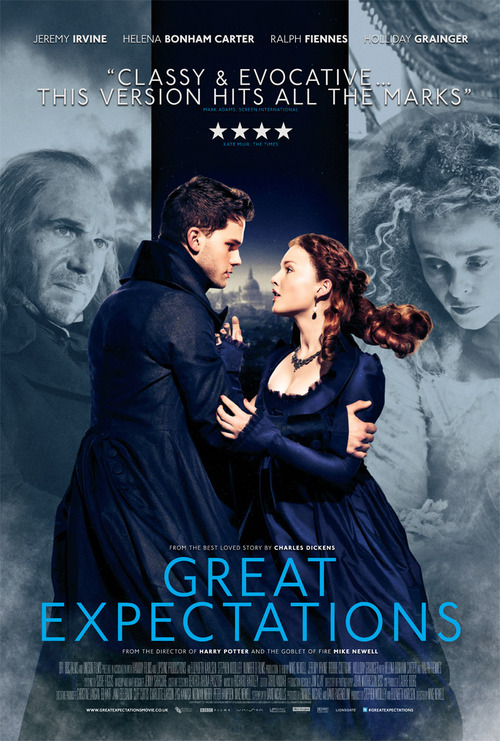
Great Expectations (2012)

Standard

Director: Mike Newell. BBC/Lipsync/Number 9/Unison/iDeal Partners Film Fund. (12A)

HISTORICAL/PERIOD/EPIC



Producers:
David Faigenblum, Elizabeth Karlsen, Emanuel Michael.
Writer: David Nicholls.
Camera: John Mathieson.
Music: Richard Hartley.
Sets: Jim Clay.

Ralph Fiennes, Helena Bonham-Carter, Jason Flemyng, Robbie Coltrane, Jeremy Irvine, Holliday Grainger, Sally Hawkins, Sophie Rundle, Ewan Bremner, David Walliams, Jessie Cave, Tamzin Outhwaite, Olly Alexander, Ben Lloyd-Hughes, Toby Irvine, Helena Barlow.

SYNOPSIS

A perverse destiny is spread before the innocent young blacksmith’s apprentice Pip (Irvine and Irvine) when he is one day called upon to go and play at the mouldering house of Miss Havisham (Bonham-Carter), a middle-aged and dotty woman, and her haughty adopted daughter Estella (Barlow and Grainger). Through a series of meetings, he becomes dissatisfied with his lot in life. He is therefore delighted to receive news as a teenager that he has come into a handsome annuity. Believing Havisham to be his benefactor, he travels to London, forgetting his nearest and dearest Joe (Flemyng), his true and faithful father figure, to pursue the life of a gentleman. It is a decision that has devastating ramifications for all around him.

REVIEW

There have been umpteen adaptations of Dickens’ perennial psychological classic stretching right back to the silent era. Writers and directors of the past have cleverly dug beneath the surface of Dickens’ warped epic to tease out the subtleties and nuances to bring an individual stamp to bear on their own productions (the recent BBC TV adaptation for instance used actress Gillian Anderson to spine-tingling effect as a child-like, whispering Miss Havisham, sexual thrall to Douglas Booth as an impossibly beautiful Pip).

As time goes by, it should come as no surprise that such literary liberties will inevitably thin, if one wishes to remain faithful to the original text.

This is writer Nicholls and director Newell’s problem – how to reinterpret Dickens’ text to make it live again when so many good ideas have already been pilfered by other artists, and still keep this as a recognisably Dickensian product (2012 being, as many of us know, the bicentennial of the author’s birth). The solution they come to – don’t reinterpret it too much, but push that bit further with the performances from a terrific cast. And, in that regard alone, this is a successful approach.

Fiennes is a terrifying Magwitch. The opening scenes capture the full shock and violence of that first chapter when he grabs Pip, menaces him and turns him upside down. Only Fiennes could then portray him later as a pentetant man, humbled by Pip the gentlemen, his very own creation and self declared son. He delicately and rather weirdly strokes Pip’s handsome face, half in  possession and half in love it seems.

Bonham-Carter seems slightly subdued in what should be the strongest part. She plays Havisham as if she is a little lost. Possibly this was the whole point of the characterisation, but the mind games she plays with Pip and Estella seem weaker as a result. What is obviously child abuse in the novel seems more like an old girl being a bit daft and having a wild eye moment in her wheelchair. None the less, she has some fun being horrible, with her pantaloons on full display for the children playing cards in front of her.

Coltrane is a strong and quite manly Jaggers, contrasting with the wonderfully supercilious and aggravating Walliams as Uncle Pumblechook who declares “Why are the young never grateful?” as a table of older diners gorge themselves ahead of the hungry, scrawny young Pip. Here is a man who would gladly sell any relative, no matter their age or infirmity, for an extra rung up the social ladder.

Newell indulges in some nice visual touches – the gloominess of the early scenes is of course almost a cliche in Dickens adaptations, all running shadows and silhouettes. There is a ready intimacy in the medium shots of the actors faces (made more obvious in the hyper sexualised turns from Grainger, who practically loses her character’s ice cool demeanour as she pants after Irvine’s sulky, testosterone fuelled Pip). The Judge at Magwitch’s trial sits almost three stories higher than the defendant, a symbolic image if ever there was.

All in all, an entertaining adaptation, it suffers only from not being especially distinguished.

Victoria & Albert Museum – ‘Hollywood Costume’

Standard

*** SPOILER ALERT!***

So despite the posters proudly displaying Judy Garland in the iconic gingham dress from The Wizard of Oz you don’t actually get to see the famous red slippers. Well, not the real ones at least because the originals featured only at the start of this exhibition, then being returned to America where they had other plans. The one’s you see at this impressively thorough cat-walk of perhaps the greatest costumes used in American movies over the past 100 or so years are direct copies made from the originals. The impressive signage that abounds at this V&A curation explains it all clearly…but it’s right at the very end of a long walk so, depending on how much you have enjoyed all of the previous pieces or how tired one is by then, you’ll either feel slightly short changed or downright miffed.

But no matter when the dazzling array of clothing and the in depth research that accompanies them is so impressive.

The curators have not only sourced the correct quotes from the designers/actors/directors involved in their creation but also reveal how the clothing was physically put together, the sometimes arduous and finger-busting weeks put into breathing such vivid life into fabric, feather and sequin and how this final product created it’s own particular corner of Hollywood mise en scene (this is when the whole design of a film contributes to a sense of time and place in the film and also a characters mood and/or thoughts).

There are particularly florid, but helpful, contributions from scions of this art such as Gilbert Adrian (MGM’s in house designer during the studios Golden Age) and Edith Head (working closely with Ingrid Bergman and on films for Alfred Hitchcock), people who not only defined the actresses they clothed, but also defined eras (Travis Banton’s suggestion that Marlene Dietrich wear top hat and tails in Morocco caused a sensation that helped boost Dietrich’s fledgling American career and encouraged many other women to wear trousers).

Smartly, the curators have arranged the costumes into three distinct sections, each representing one of the three parts of the creative process. Deconstruction (the research phase), Dialogue (exploring the collaboration between designers and film-makers) and Finale (this, a roll call of the most famous outfits used in Hollywood films, feel like entering a decapitated but very familiar night club, where the heads of the most famous stars in cinema are replaced with TV screen projections).

There is obvious cross-over between some of the costumes in any of these sections and, obviously, one can see how the dialogue section might actually come first in some cases (particularly with Raiders of the Lost Ark, in which Steven Spielberg had a vision in his head already about how Indiana Jones should look – designer Deborah Nadoolman, one of the curators, went on to fine tune the look that made Harrison Ford a star). There are also some detractions – Michelle Pfeiffer’s catwoman outfit from Batman Returns is almost missed by having her crouched and half-hidden atop a wall.

But these are minor worries when, for a movie geek such as I, there is such an awesome range of real pieces to feast your eyes on. Greta Garbo’s velvet dress in Queen Christina (1933 and, my, wasn’t she small in real life?), Hedy Lamarr’s lamarvellous, ridiculous attire from De Mille’s equally ridiculous Samson and Delilah (1949) to blasts from the past Bessie Love in The Broadway Melody (1929) and the largely forgotten silent vamp Louise Glaum in the titillatingly titled Sex (1920).

Aside from these extravagant dresses, one thing that really does hit home is how you never quite realise how the more ordinary clothing in a film (Robert Pattinson’s plain suits in the Twlight films to Brad Pitt’s red jacket in Fight Club) helps create a sense of a character’s self just as effectively, but in a more subtle, nuanced way than any Ostrich feather fascinator or intricately sequined Tudor era frock can.

More information about the exhibition can be found here.

An article by Deborah Nadoolman about the exhibition can be found here.

The Master (2012)

Standard

Film review by Jason Day of The Master about a disturbed man from the wrong side of the tracks and the evangelist who tries to save his soul. Starring Joaquin Phoenix and Philip Seymour Hoffman.

Drama


Continue reading