Film review of the Michael Mann directed action thriller starring Chris Hemsworth and Viola Davis.
Director: Michael Mann.
Action/Adventure/Fantasy


Film review of the Michael Mann directed action thriller starring Chris Hemsworth and Viola Davis.
Director: Michael Mann.
Action/Adventure/Fantasy

Film review of the Disney fantasy starring Julie Andrews and Dick van Dyke.
Director: Robert Stevenson. Disney (U).
Action/Adventure/Fantasy


Director: Gary Ross. Lionsgate/Color Force. (12a).
ACTION/ADVENTURE/FANTASY

Film review of the action thriller Black Sea, starring Jude Law and Scoot McNairy.
Director: Kevin Macdonald. Film4/Cowboy Films/Etalon Film
Action/Adventure/Fantasy

Producer: Kevin Macdonald, Charles Steel.
Writer: Dennis Kelly.
Camera: Christopher Ross.
Music: Ilan Eshkeri.
Sets: Nick Palmer.
Jude Law, Scoot McNairy, Tobias Menzies, Grigoriy Dobrygin, Ben Mendelsohn, Jodie Whittaker, David Threlfall, Michael Smiley, Karl Davies.
In order to make good with his former employers, a submarine captain (Law) takes a job with a shadowy backer to search the depths of the Black Sea for a Nazi submarine rumored to be loaded with gold.
This review feels more like a premiere for me, being my first chance to sample MK’s Cineworld after several weeks on ‘the other side’. Despite the on-going refurbishment work previously reported by Total MK and some minor gremlins in the works (a few recalcitrant lights in the auditorium I sat in having to be persuaded into submission), this was a refreshingly palatial experience, sat amongst the distinctive, sumptuous blood reds of Cineworld in massively comfortable seats with plenty of a leg-room for a nearly-6 footer.
It was also briskly busy for a 6pm Friday screening, about 80 people for a film that has not been heavily promoted – have I been frequenting the wrong type of multiplex? Next up is their Super Screen, to be unveiled in a week’s time, but until then on with the actual review.
This is a beefy, solid if slightly half-hearted action film, manly, sweaty and gruff. Rather like the now muscled star Law, here leading as the renegade captain of the submarine, a team player willing to put his team’s lives on the line to secure riches on the sea bed, in order to stick one to ‘the man’. He’s wearing the years surprisingly well and his performance bristles with the kind of intense but sensitive conviction we have come to expect from him, persuasive and controlled but also increasingly unfocused, he rolls around on sailors barrel legs with slightly menacing eyes.
This manned-up turn benefits from a commendable sounding Scottish accent, unfortunately let down by what seems an over-enunciating mouth and painful jaw jutting as he barks his orders out. He looks like he’s just chomped down on an out of date haggis found at the back of the sub’s kitchen cupboards.
The cast that make up his crew look like appropriately moth-eaten Argonauts to his modern-day Jason, providing salty and seasoned supporting acts. Of especial note is Threlfall (from TV’s Shameless) as an old-timer riddled with emphysema but still able to spit out the one-liners. When one character, on seeing the rusty submarine they will use to find the bullion, states “This wreck’s gonna sink”, Threlfall replies “It’s a fucking useless sub if it don’t”. It’s a minor role, the same type of sea dog you’ve seen in a million boat/sub/navy films, but the work Threlfall has expended makes meeting him a worthy experience. This is the type of guy you could meet down the pub and enjoy a few jars with.
But for every line of great dialogue in a more or less solidly crafted movie such as this, there are also corny, ‘manly’ platitudes and head-scratching plot holes that litter carelessly constructed action film scripts.
I’ll choose to forget the gratingly poor line from Law about big business choosing to “flush shit like us away, but now the shit is fighting back” and focus instead on what seems like far-fetched engineering principles (why does this rusty submarine even leave land without any preparatory work, that takes place at sea? Would it really survive such a gruelling journey?), clunky additions to the story (would a submarine captain as experienced as Law really pick a young and completely inexperienced man such as Tobin [Bobby Schofield] to join his crew on such a dangerous mission?) and the fact that the script is nothing more than a water-bound update of Greed (1925) and Treasure of the Sierra Madre (1948).
Director Macdonald (The Last King of Scotland, 2006) shows himself capable of creating stomach tightening, tense moments, particularly the seabed walk toward the sunken Nazi sub that had me squirming in my seat. The paralysing, lonely dark of being underwater already creates a sense of unease and he capitalises on this to the max.
It’s a shame therefore that he doesn’t make a bit more of the claustrophobic interior of Law’s vessel where the horror of human avarice starts with a bang but peters out with a soggy whisper.
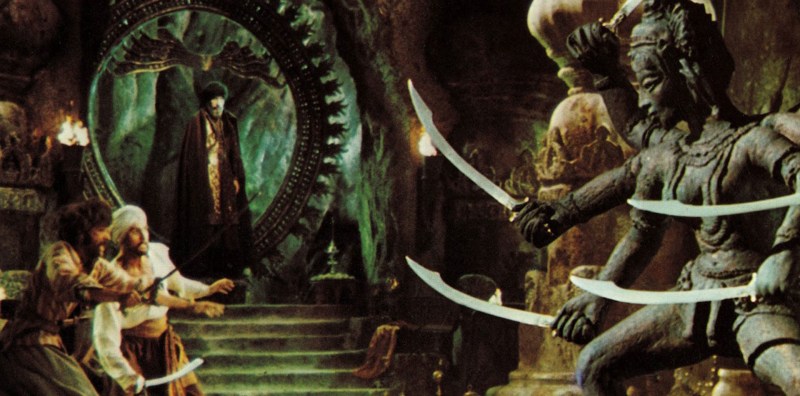
Director: Gordon Hessler. Columbia (U)
ACTION/ADVENTURE/FANTASY
Producers: Charles H. Schneer, Ray Harryhausen.
Writer: Brian Clemens.
Camera: Ted Moore.
Music: Miklos Rozsa.
Sets: John Stoll.
John Phillip Law, Caroline Munro, Tom Baker, Douglas Wilmor, Martin Shaw, Gregoire Aslan, Kurt Christian.
Sinbad the sailor (Law) battles with the evil Black Prince Koura (Baker), who wants a golden tablet that leads the way to a mysterious island that contains a magical fountain that gifts youth and riches on the person who steps into it. Accompanying him are slave girl Marjiana (Munro), a disfigured Sultan (Wilmer) and loyal crewman Shaw. A series of fantastical monsters stand in their way.
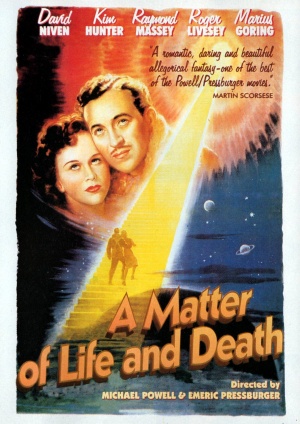
Directors: Michael Powell, Emeric Pressburger. The Archers/Eagle-Lion/Universal. (U).
ACTION/ADVENTURE/FANTASY

Producers: Michael Powell, Emeric Pressburger.
Writers: Michael Powell, Emeric Pressburger.
Camera: Jack Cardiff.
Music: Allan Gray.
Sets: Alfred Junge.
David Niven, Roger Livesey, Raymond Massey, Kim Hunter, Marius Goring, Abraham Sofaer, Robert Coote, Joan Maude, Kathleen Byron, Bonar Colleano, Richard Attenborough.
SYNOPSIS
During WWII, British bomber captain Peter Carter’s (Niven) plane is hit by enemy fire killing his crew. In the final minutes as he crashes, ground crew Wren Joan (Hunter) picks up his distress call and the two fall in love as he narrates his last words. Bailing out suddenly, he somehow survives when he should have died, leading him to plead his case to remain living in a celestial court, watched over by a jury and observers of the great and the good of history.
REVIEW
Powell and Pressburger collaborated on a series of lushly vivid technicolour fantasies from their Archers Studio in London during the 1930’s – 1950’s, very nearly taking on Hollywood at its own game with lavish melodramas. This rumination on the meaning of being alive, also called Stairway to Heaven in the states, is one of the most glittering examples of their genius.
A vast film in scope, ambition and design we open appropriately on a map of the galaxy with the narrator informing us “This is the universe. Big, isn’t it?”. The understatement to end all understatements.
But Powell and Pressburger were able at this point in their conjoined careers to conjure up the most extraordinarily realised fantasy realms on celluloid, usually helped by gifted cameraman Cardiff.
Fog banks roil protectively over a little England, vivid red beacons pulse behind Hunter as she desperately engages Niven in life-saving conversation, the consuming orange of the fire in his plane throbs around him and later and most especially the eye-popping sets for a black and white heaven, including a mighty silver escalator to judgement in the most Godly and palatial of courtrooms. No need for grecian columns here, so full plaudits to designer Junge for realising this most impressive of astronomical architecture. He also reflects the humour of the writers be endorsing their view of heaven as a friendly but officious monochrome idyll, where bottles of Cocoa Cola are freely available from vending machines on arrival.
The visual style can be seen throughout with some neat trick shots: Niven goes under anaesthetic and we see from the inside his eye lid closing slowly in all it’s criss-crossing blood vessel glory. A psychadelic bloodstream then leads us back to his heavenly courtroom trial. Later, he and Conductor 71 (Goring) observe his surgery and casually pass through some doors.
There is an almost thrilling use of close and mid-close up throughout, particularly during the opening scenes as Niven and Hunter commence their courtship over the air waves, shockingly escalating the closeness of their conversation. Cardiff was one of the greatest cinematographers in cinema history and cleverly utilises the shadows cast by set props to isolate parts of Hunter’s face to embellish this approach, focusing on her eyes, nose and mouth.
The lush and overwrought aspect of the film is complemented in the intense and fevered performances of the cast, particularly Niven who was never more sincere or earnest as he innocently pursues wide-eyed military miss Hunter.
Better still are the legal defence he employs to cast him back to his temporal place, British Livesey (a P&P regular) and American star Massey as an Independence War hero, who memorably argue with each other about the faults of each nation and battle for Niven’s soul. As a mark of the esteem these film makers were held internationally, when Massey was offered the potential of a role in this film he remarked immediately to the producers, “For The Archers anytime, this world or the next.”
Oh dear though, for all this beauty, there is also ugliness. For the sensibilities of this era we have to suffer the appalling vision of racial segregation. Nurse/angel Byron notes at the beginning of the film that heaven is reserved for all “whether black or white, rich or poor”, but all of the black soldiers who have died during the war efforts are seated on their own, in tonal contrast to the Puritans and French revolutionaries around them.
But this is to see a film through the prism of 70 years earlier with the full benefit of today’s Equality and Diversity aware eyes. We can then feel some justice that when Livesey asks for a new jury of entirely American people, he gets American’s of every creed and colour.
Right down the cast list is a very young Attenborough, almost unrecognisable with a full head of hair.
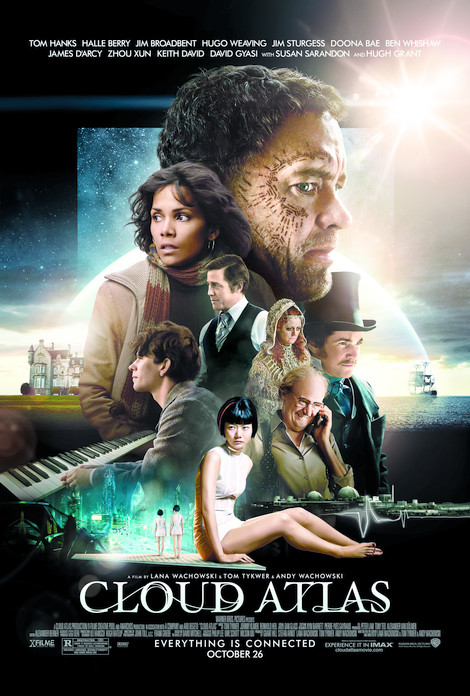
Directors: Tom Tykwer, Andy Wachowski, Lana Wachowski. Cloud Atlas/X-Filme/Anarchos et al (15)
ACTION/ADVENTURE/FANTASY

Producers: Stefan Arndt, Alex Boden, Grant Hill, Tom Tykwer, Andy Wachowski, Lana Wachowski.
Writers: Tom Tykwer, Andy Wachowski, Lana Wachowski.
Camera: Frank Griebe, John Toll.
Music: Reinhold Heil, Johnny Klimek, Tom Tykwer.
Sets: Hugh Bateup, Uli Hanisch.
Tom Hanks, Halle Berry, Jim Broadbent, Hugo Weaving, Jim Sturgess, Doona Bae, Ben Whishaw, Keith David, James D’Arcy, Xun Zhou, David Gyasi, Susan Sarandon, Hugh Grant, Robert Fyfe, Gotz Otto, Sylvestre Le Touzel.
SYNOPSIS
Jumping between different time periods and based on David Mitchell’s novel, the lives of seemingly unconnected people across the ages are brought together as their actions impact on others in the past, present and future. One soul turns from a killer into a hero and another sparks a revolution that reverberates across centuries and throughout the cosmos.
REVIEW
I love the ephemeral existence of going to the movies. How a film can lift you up to take you far, far away from the thuddingly dull mundanity of everyday life for a precious couple of hours and plop you in another world, either one recognisably like the one you will go back to or something completely different. Cloud Atlas, encompassing as it does so many worlds, is a valiant if not entirely successful example of this.
It resembles a beguiling, dazzling but uncomfortable mash-up of D.W. Griffith’s Intolerance (1916) and David Lynch’s Dune (1984, the poster closely resembles that wobbly sci-fi epic’s). Despite sharing those film’s tendencies to reach far beyond its grasp, it has a lot more heart amidst the artifice and grandeur than they ever managed.
As Forrest Gump once noted about boxes of chocolate, “You never know what you’re gonna get” and you certainly don’t with Cloud Atlas.
No surprise then that Forrest himself (Hanks) crops up in one of the panoply of roles on display. He is game if nothing else; successful isn’t always at the forefront of your mind though when you see him as either a vicious, Dublin gangster with a mouthy ‘Oirish’ accent or a balding, garrolous Scottish landlord. Where he does strike lucky is in the futuristic sequences as a schizophrenic goat-herder romancing Berry or a terrifying ship’s doctor slowly poisoning rich passenger Sturgess.
But when you’re playing seven different roles, as most of the cast are, you have a high betting average of getting at least one of them right. The casting agents deserve all the plaudits for probably sweating blood and tears to assemble these people in one film.
The rest of the starry cast are pretty much up for it and there are some stylish turns amidst the dross: Berry as a seductive Jewish emigre, Broadbent as a bent publicist imprisoned in an old people’s home and determined to escape, Bae as a monotone, revolutionary clone in futuristic Korea. D’Arcy impresses the most in his roles, whether as a gay, whistle-blowing scientist in 1930’s Britain and 70’s America or a blankly efficient futuristic interrogator.
Latex.com could probably have floated themselves on the stock exchange after the exemplary overtime the make-up team put in to making the cast look (slightly) dissimilar for each characterisation.
The problem with film’s such as these, massive in scale and scope, disparate stories stretching across centuries of existence, is the need for an effective link to weave all of the elements together. Intolerance failed on a huge level; using Lillian Gish as a woman eternally rocking her child in a cradle merely baffled WWI audiences and frustrates modern viewers. Cloud Atlas has a similar problem; the remnants of some good stories on their own are quite strong, but without an effective link in the narrative until much later in the film, they seem quite adrift.
When the theme of the film becomes apparent (a few choice lines that hug the stories together), it’s difficult to tell whether one is knocked side-ways by the film-makers’ audacious approach, relieved that a somewhat gruelling journey is over or simply desperate to go the toilet. Probably all three at the same time, though difficult to tell in what order (at 2 hours 44 minutes in duration, the latter feeling might figure largely).
The propensity for film-makers to make such large-scale films when something more concise would suffice is a matter for further debate elsewhere, what isn’t is their writer’s lack of humour to sustain an audience on such long trips. Apart from Broadbent’s scenes as the publicist, seen in flash-back sustaining serious injuries from a well positioned cat when he is trying to lose his virginity, there is something of a funny-bypass here. Still, the images are sometimes quite incredible and it’s fun to scratch your head and try to piece together the celluloid jig-saw.

Director: Peter Jackson. NewLine/Wingnut/MGM/3Foot7. (12A)
ACTION/ADVENTURE/FANTASY
Producers: Carolynne Cunningham, Peter Jackson, Fran Walsh, Zane Weiner.
Writers: Fran Walsh, Philippa Boyens, Peter Jackson, Guillermo del Toro.
Camera: Andrew Lesnie.
Music: Howard Shore.
Sets: Dan Hennah.
Ian McKellan, Martin Freeman, Richard Armitage, Ken Stott, Graham McTavish, William Kircher, James Nesbitt, Stephen Hunter, Dean O’Gorman, Aidan Turner, John Callen, Peter Hambleton, Jed Brophy, Mark Hadlow, Adam Brown, Ian Holm, Elijah Wood, Hugo Weaving, Cate Blanchett, Christopher Lee, Andy Serkis, Sylvester McCoy, Barry Humphries, Kiran Shah, Benedict Cumberbatch.
SYNOPSIS
60 years before his nephew joined another fellowship, to destroy a magical ring that has the power to enslave all of Middle Earth, unassuming Hobbit Bilbo Baggins (Freeman) lives a comfortable, sheltered life in the beloved Shires. That is until the wizard Gandalf (McKellan) and a group of raucous dwarves (led by Armitage) show up on his doorstep. Bilbo is taken out of his comfort zone on an adventure to recapture the Dwarve’s fabled home city, taken years earlier by a ferocious dragon, encountering dangerous creatures and finding he has unexpected depths along the way.
REVIEW
Peter Jackson is a man who knows how to make big movies. Very big. Colossal in fact. And if he throws caution to the wind in terms of economy of scale, well good on him and so be it. What he is in dire need of however is a stopwatch. And a gutsier editor.
The combined length of his Lord of the Rings trilogy weighed in at around an arse-numbing nine hours (and that’s the slimmed down theatrical releases – there were extended versions released on DVD), King Kong concluded only after a rather unnecessary three hours plus. It is probably no surprise that he filmed so much footage for this adaptation of the first and singular novel in Tolkein’s Middle Earth series that it was easier to release it as another trilogy.
It also makes good box office sense; these films are expensive to make so two extra films means more box office ‘kerching’. It has also lead to an accumulation of rather a lot of protracted, repetitious, disposable events, scenes and moments in a film that runs to two hours 49 minutes in its original movie theatre version. The opening preamble, for instance, with the older Bilbo (Holm) and Frodo (Wood) seems tacked on to help audiences familiarise themselves with the first book being adapted last. Given the mighty publicity machine deployed though, the value of this scene is questionable.
One can’t help but imagine how much cheaper these film’s would be, if Jackson shaved half an hour off each one during the development stage.
Perhaps this feeling is wholly a question of taste at the end of the day; with nearly a $billion in gross takings for this first instalment as of Jan 2013, who am I to judge? But judge I will when I feel a creeping sense of the familiar and duplicated throughout.
I freely admit to not having read any of Tolkein’s much admired books. Perhaps I lack perspective on certain things, but as a film viewer and reviewer, it didn’t aid my enjoyment to come across settings already visited (the Dwarf city of Moria, where Gandalf was ‘killed’ in the first Rings film) and situations that smack of the ‘been there, seen it’ (the eagles who fly to the rescue, as in the second Rings film). This ‘samey’ feel probably explains why the London Evening Standard thought this was a ‘fair to middling return to Middle Earth’.
The set-pieces and special effects are, of course, magnificently realised. In terms of head-swirling spectacle, The Hobbit delivers in spades. 3D is used exceptionally well in many sequences, but if any film genre was made to be told in an extra dimension it is this. But this is par for the course; we know Jackson and his too-numerous-to-mention-individually technical team can deliver the goods here. He really needed a different tack to make this new trilogy stand out from it’s forbears.
The musical sequences are cute but a step in the wrong direction; are we heading into Cameron MacIntosh territory? Surely we want something other than Les Middle-arables. Could it be emotional intimacy in amongst the CGI? Are we hankering for less people but better character development?
Freeman is saddled with much of the dramatic weight of the film as his character is the main person who will progress and mature, but he is mostly sidelined until the film kicks into life (thank heavens we leave the Shire behind us). It will be interesting to see how far he pushes the next two films.
There are welcome returners in the cast, dotted amongst the newbies – Blanchett and Weaving as almost hypnotic Elvish leaders, Lee shows the beginnings of his turning to the dark side, Serkis is still unrecognisable as the dissociative Gollum. Of those new cast members who score strongest (or loudest at least), Nesbitt is Dwarf Bofur, Stott is older Dwarf Balin and former Dr Who McCoy makes a surprise cameo as a far too eco-friendly wizard (let’s just say it is no surprise he is known as ‘The Brown’). The dwarves help make sure that the comedy moments (such as when they are BBQ’d by two hungry trolls) carry the film along during the longuers. It’s a shame, then, that these are few and far between. Let’s hope that, as with the first part of Lord of the Rings, things pick up nicely after this lumbering character introduction.
Director: Ang Lee.
DRAMA

Producers: Ang Lee, Gil Netter.
Writer: David Magee.
Camera: Claudio Miranda.
Music: Mychael Danna.
Sets: David Gropman.
Suraj Sharma, Irrfan Khan, Rafe Spall, Ayush Tandon, Gautum Belur, Adil Hussain, Tabu, Gerard Depardieu, Andrea Di Stefano.
SYNOPSIS
A strange journey awaits the highly intelligent and ever curious Pi (Sharma as a teenager, Khan as an adult) when his family emigrate from India to Canada, taking with them the creatures from their zoo that they will sell on arrival. A storm sinks their ship leaving Pi adrift on a lifeboat, the only survivor. That is, apart from a ferocious tiger, enigmatically known as Richard Parker. Recounting his ordeal as an adult (Khan), Pi learns to subdue the tiger and coexist with it, he not only finds how to survive his ordeal mentally but begins to understand what God is.
REVIEW
A film to put you in a good mood, despite the admittedly arduous plot line. For me it helped that the showing I attended featured no trailers or adverts – so a thumbs up before the opening credits had rolled!
A difficult novel to film, but Lee shows his extraordinary intelligence as a film-maker throughout. It’s always arguable whether the framing device of having flashbacks from a character to his younger self is either a necessary tool to position the narrative or an irritating, disposable stylistic folly that can weigh down the ebb and flow of the piece, but Lee has made sure to avoid this pit-fall. The seamless editing for a start sees us gently taken from wistful recollection to storm tossed seas, using the ripple of water as an appropriate lap dissolve between the two.
A lifeboat set film doesn’t inspire a viewer with confidence in the action stakes (Hitchcock’s Lifeboat being a suspenseful exception), but the time whizzes by thanks to a number of carefully spaced set-pieces from the magnificent, balletic shipwreck (rendered with sea-sickness inducing reality), a phosphorescent humpback whale breaching over Pi’s little boat and the downright bizarre ‘Meerkat Island’ (try comparing this community!). The tiger is brought to roaring life by the best CGI technicians, but Lee’s main achievement on the mechanical side of this film is to correctly utilise the 3D technology to embellish his story, rather than to swamp it or use only occasionally for throw away spectacle.
Pi is an engagingly resourceful character at all points in his life, enhanced by the pitch-perfect performances of those playing him. Each is able to show the progression of boy to man but Sharma, with no previous acting experience to his credit, should take most of the plaudits as the Pi who is cast adrift, but never loses his way. Khan has the lion’s share of the laughs as a jovial adult Pi. Depardieu makes an unexpected cameo as a foul, racist cook who abuses Pi’s family and almost starves them. Spall has a sweeter supporting turn as the Canadian novelist who wants to turn Pi’s history into a book.
Forget reviews that point out the similarities to the deeper aspects of Yann Martel’s novel, that being an existential rumination on the nature and form of God. Lee has paid decent lip service to this side of the story and a rich vein of religious and self discovery pervades the film. But he has wisely chosen to make something of beauty and wonder, as much as about the world around us than of a higher power, rather than trying to create a cinematic theology lecture.

Film review of the action film starring Bruce Willis about a group of European terrorists who take over a Los Angeles skyscraper during a Christmas party.
To like this review, comment on it or to follow this blog, scroll to the bottom of the page. Use the search function on the left of the screen to look up other reviews.
Director: John McTiernan. Twentieth Century Fox/Gordon/Silver. (15)
ACTION/ADVENTURE/FANTASY
 CineSocialUK