Blackmail (1929)

Standard

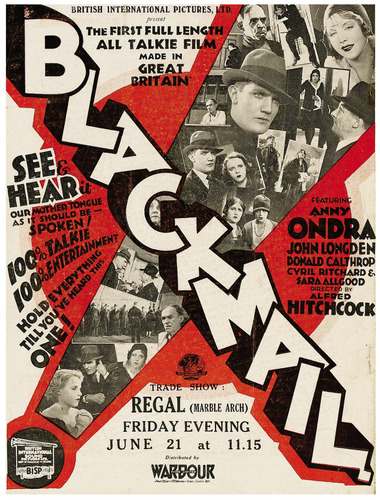
Director: Alfred Hitchcock. British International Pictures.

SILENT

 

Producer: John Maxwell. Writer: Alfred Hitchock. Camera: Jack Cox. Sets: W.C. Arnold.

Anny Ondra, John Longden, Donald Calthrop, Sara Allgood, Charles Paton, Cyril Ritchard, Hannah Jones, Sam Livesey.

SYNOPSIS

Young Alice (Ondra), bored with her workaholic Detective boyfriend (Longden), dumps him one night to spend a night on the tiles with an artist (Ritchard) who has taken a shine to her. Invited into his flat, he forces himself on her, forcing her to stab him in self-defence. A creepy man (Calthrop) who earwigged on their earlier conversation attempts to blackmail her.

REVIEW

Rarely seen (and more the pity) as this entirely silent film of Hitchcock’s more famous, semi-talkie version is a stand-alone piece itself, seen to be of better quality.

Blackmail is undoubtedly a visual binge for the eyes, one they will drink in heartily, happily suffering a celluloid hangover. The feats accomplished here are more surprising when one considers that at this time in cinema the silent camera was only just experiencing the dizzying liberation from its usually static confines. Directors such as Hitchcock, Eisenstein and Murnau were now fully confident in utilising all aspects of the art form from acting to camerawork and editing to result in the most thrilling motion pictures.

Here, Hitchcock almost knocks the viewer out with an audacious series of shots and techniques:

His frequent and innovative use of mobile camera as he swings his camera from one character to another, jumps into a ringing phone and also tracks his actors as they walk around the sets.

He performs an immaculately staged craning shot, swiftly following Ondra and Ritchard as they ascend four floors of a Chelsea townhouse with elevator smoothness. Camera wise, Blackmail outclasses most other films of this period, if not all of them.

Hitchcock had already started developing his very own mise en scene in his earlier films’ and would continue to develop this throughout his career, tickling film critics and theorists the world over, as they look ever deeper for psychosexual meanings behind ‘The Master’s’ images.

There are the visual motifs (the outstretched hands of various characters mimics the hand of the murder victim, as if he taunts Ondra from beyond the grave), the car wheels that whirl around, giving chase to not only a criminal at the film’s opening but then Ondra and her complicit lover thereafter.

There are the visual jokes of course. As Ondra walks home from committing her double sins, the sign on a theatre notes the play is a comedy; an advertisement billboard extols the virtues of a gin that is “white as purity”. Hitchcock’s trademark appearance before the camera is as a commuter harassed by a little boy on the underground.

There is also a juicy humour interspersed throughout; when Ondra comes to the police station, ostensibly to ‘fess up, the policeman is incredulous that this could see “women detectives in the yard”, the obvious anachronism not being lost on an appreciative audience.

The technical details of how the sound and silent versions cross-over and how the films came to be made in such a manner could fill a whole other review, but suffice to say contrary to legend, Hitchcock almost certainly planned Blackmail from the outset as finishing at least a part talkie. But the dual production style helped both films contrast and also complement each other in the end.

Ondra, despite her notoriety these days as one of the most unfortunate casualties of the sound transfer (her Polish accent, deemed impenetrable for British audiences, meant she mouthed her lines for the sound version whilst actress Joan Barry spoke hers from nearby on set) turns in a delicate, tortured performance as a flighty girl caught in an escalation of Hitchcockian coincidence. She also displays one the finest pairs of legs in the movies.

Allgood, playing her devoted mother who nags incessantly about doing the cleaning whilst her murderess daughter is being conned in the parlor, would go onto a successful career in Hollywood that ultimately saw her nominated for a Best Supporting Actress Oscar for How Green Was My Valley (1944).


Beggars of Life (1928)

Standard

Film review by Jason Day of the silent movie Beggars Of Life starring Louise Brooks, Wallace Beery and Richard Arlen. Directed by William A. Wellman.

Silent


Continue reading

Broken Blossoms or The Yellow Man and the Girl (1919)

Standard

Film review, written as a social services case, by Jason Day of the silent melodrama about a poor, abused girl in Victorian London who is befriended by a Chinese man. Starring Lillian Gish and Richard Barthlemess.

Silent


Continue reading

Intolerance: Love’s Struggle Throughout the Ages (1916)

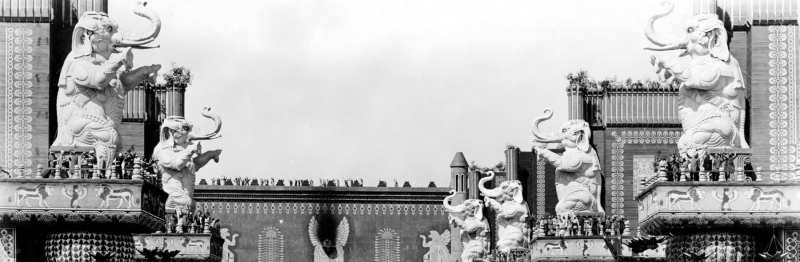
image still babylon intolerance griffith
Standard

Film review by Jason Day of Intolerance: Love’s Struggle Throughout the Ages, the epic silent movie directed by D.W. Griffith and starring Mae Marsh and Robert Harron.

Silent


Continue reading

Way Down East (1920)

Standard

Director: D.W. Griffith. United Artists.

SILENT


Producer: D.W. Griffith. Writer: Anthony Paul Kelly. Camera: G.W. Bitzer. Music: Louis Silvers. Sets: Clifford Pember, Charles O. Seessel.

Lillian Gish, Richard Barthlemess, Lowell Sherman, Burr McIntosh, Kate Bruce, Mary Hay, Creighton Hale, Emily Fitzroy, Porter Strong, George Neville, Edgar Nelson.

SYNOPSIS

A young and naive country girl (Gish) is tricked into a fake marriage by a wealthy cad (Sherman). She becomes pregnant and he abandons her. Having the baby out of wedlock, it soon dies and she leaves. Finding work in the home of Squire Bartlett (McIntosh), whose son David (Barthlemess) takes a shine to her, she finds happiness. But when Sherman turns up on their doorstep, the Squire finds out about Gish’s past and orders that she be cast out into a storm. Having kept quiet for so long, Anna points the finger of blame onto Sherman and leaves. David chases after her and has to rescue her from an ice-flow.

REVIEW

High drama (and, at nearly 2 and a half hours, a lengthy one too) from Griffith, with the hoariest, mustiest of plots, even for Victorian theatre (it’s based on a play by William Brady and Joseph Grismer that had already been filmed twice).

This was the first of two romantic epics for Griffith that were his last films to turn a decent profit before an inglorious run of flops in the 1920’s that effectively rendered him unemployable and it is justifiably one of his most fondly remembered pictures.

Pastoral dramas such as this were popular with American audiences and Griffith uses the halcyon atmosphere of a country idyll to show how this can mask social injustice and prejudice with consummate skill. He was, however, a complete idiot for letting his penchant for tactless and inappropriate comedy spoil the fine story.

None the less he builds the drama excellently with an impeccable grasp of editing and camerawork as he runs to the now famous climax when Barthlemess has to jump across moving ice sheets on a frozen river to rescue Gish (yes, that really is her floating toward the frigid waterfall). It still carries a certain excitement to this day, thanks to Griffith’s renowned skill at cross-cut editing.

Of this scene, Gish later claimed to have permanently damaged one of her hands after trailing it for extended periods in the icy water. Griffith, a perfectionist, demanded several takes and Gish, an actress who sought perfection in her work with equal commitment, continued without complaining.

The top form silent cast are led by the luminous Gish, who skilfully manages to not come across as sickeningly sweet and bears life’s vicissitudes with great dignity considering a well placed kick to some of the male characters would have gone down a treat. Barthlemess displays true grit, despite being a little slow to cotton on to Gish’s situation and Sherman is a delightfully charming arsehole.

Although no cameraman is officially credited, Griffith’s regular Bitzer was on hand, with help from Hendrik Sartov and Charles Downs. The results are matchless.

The Wind (1928)

Standard

Film review of the silent movie starring Lillian Gish about an innocent girl forced into marriage in the Texan desert.

Director: Victor Seastrom (Sjostrom). MGM

DRAMA


Continue reading

Varar Engang, Der/Once upon a Time (1922)

Standard

Director: Carl Theodor Dreyer. Sophus Madsen Film.

SILENT

Producer: Sophus Madsen. Writer: Palle Rosenkrant, Carl Theodor Dreyer. Camera: George Schneevoigt. Sets: Jens G. Lind.

Clara Wieth, Svend Methling, Peter Jerndorff, Hakon Ahnfeldt-Ronne, Torben Meyer, Mohamed Archer, Henry Larsen, Lars Madsen.

SYNOPSIS

A spoilt Princess (Wieth) turns down all manner of suitors with a haughty impartiality that increasingly vexes her father the King (Jerndorff). When she turns away the Prince of Denmark (Methling), the Prince decides to trick her into falling in love with him by disguising himself as a poor but romantic farmer. Through accident and circumstance, they are thrown together, but not before he teaches her a lesson in respect.

REVIEW

Thought lost for many years, this early, light comedy from Dreyer (later the master of deep, moody and contemplative family drama) reveals to an audience why it chose to hide itself for so long, rather than giving us any insights as to the development of its director.

The full version of the film is now well beyond our reach, now it is merely a patchwork effort cobbled together from fragmented stills, publicity shots, title cards and the remnants of the old film stock. Dreyer was reportedly unhappy with the finished product all his life, lamenting that this was an experiment in focusing on atmosphere above character that showed him never to try it again. These are feelings this reviewer shares, for the whole is indeed disappointing, uneven and hamfisted.

Story wise, we are dealing with a fairytale that quickly takes a turn around a dark corner. It is similar in some respects to Shakespeare’s The Taming of the Shrew and with all of the duplicitous dressing up, just as aggravating. Dreyer throws in a lot to what is essentially quite simple fare; it doesn’t help us in the modern age that segments are missing and the film’s various loose ends soon knot the film into an incoherent mess that sucks the life out of your attention span.

There are some tasty matters. The Princess’ capriciousness is deadly – faced with pearls or poetry from the dashing gallants in want of her hand, she condemns them all to death. Later on, after she herself is expelled from the castle to scratch out a life in a hovel, she sees a real man hanging from a tree. The Prince, whilst in self-imposed exile in the forest licking his wounds, is visited by a mystical peddler who offers him a magic kettle with which he can see his future wife. No crystal balls in this fairytale kingdom – functionality and clairvoyance are conveniently intertwined. The performances are amusing; Wieth and Jerndorff in particular have huge fun.

One thing that is readily apparent – big kroner was lavished on the sets and beautiful costumes (even if, on closer inspection, they are contrived from a few different periods).

Tol’able David (1921)

Standard

Film review by Jason Day of the silent drama starring Richard Barthelmess. Directed by Henry King.

Director: Henry King. Inspiration Pictures/First National

SILENT


Continue reading

The Scarlet Letter (1926). Stunning, beautiful silent film based on Nathaniel Hawthorne’s novel

image lillian gish lars hanson scarlet letter
Standard

Film review by Jason Day of the silent movie adaptation of Nathaniel Hawthorne’s novel The Scarlet Letter about an adulteress woman in a puritan community. Starring Lillian Gish.

Silent


Continue reading

The Thief of Baghdad (1924)

Standard

Director: Raul Walsh. United Artists.

SILENT


Producer: Douglas Fairbanks. Writer: Elton Thomas, Lotta Woods. Camera: Arthur Edeson. Music: Gaylord Carter. Sets: William Cameron Menzies. Special Effects: Hampton Del Ruth.

Douglas Fairbanks, Snitz Edwards, Charles Belcher, Julanne Johnston, Sojin, Anna May Wong, Brandon Hurst, Tote Du Crow, Noble Johnson.

SYNOPSIS

Ahmed (Fairbanks) is the Prince of all Thieves in ancient Arabia, a young man who “takes what he wants” when he wants it. That is until he meets the ravishing Princess (Johnston) and decides to abandon his career, temporarily at least, in order to woo her. But he has first to complete many dangerous tasks to win her hand, as an evil Mongol Prince (Sojin) is after her too.

REVIEW

The great granddaddy of all Arabian Nights fantasy films is still thrilling, fun, rousing entertainment nearly 100 years after its premiere.

Early cinema swashbuckler Fairbanks, the dash good-looking, athletic movie legend, husband of Mary Pickford, was at the peak of his Hollywood powers so was obvious casting in the role of the Prince of Middle Eastern kleptomaniacs, a one man crime wave for whom the ASBO couldn’t have been invented quickly enough. This is his most fondly remembered film in a career that saw him play  Robin Hood and The Man in the Iron Mask and Zorro. As an example of the ‘Star System’ that operated in Hollywood at this time (where movie roles were moulded around the personality, or at least their public personality, of the star who was playing them), so the film is tailor made for Doug’s brand of bouncy gymnastic gyrations and boyish, carefree good larks.

If Johnston’s insipid turn as the Princess ultimately proves irritating, this was probably more because of the convention for female leads in Hollywood action films of the silent era to swoon and pale into insignificance next to their macho co-star. At least we have a smashing, exotic support cast: Wong excels as the Johnston’s duplicitous Mongol maid and the mysteriously named Sijon is a creepy villain in the Nosferatu vein.

Its influence also stretches across the decades, due in most part to Menzies’ astonishing Baghdad design, a unique ‘Arabopolis’ with towering minarets, art deco furnishings and a grandly synthetic beauty (the undulating fabric that makes up the Midnight Sea prefigures a similar design used in Fellini’s Casanova). Anyone watching Disney’s vulgar, noisy version of Aladdin with gobby Robin Williams as Genie will also see the similarities. Menzies would go on to design many other famous films and this was an early indicator of his extravagant style.

Made back in the day, long before CGI and computers, some of the ingenious special effects have managed to withstand the test of time. The flying carpet is still humorous and convincing and the trick photography in the Magic Crystal is impressive. Unfortunately, the winged horse and underwater sections (Doug’s walk toward the Mermaids’ Lair stinks) are rather less so and invoke some hilarity.

Despite this and the rather hefty running time (2 and a half hours no less), director Walsh manages to inject enough pace and verve to provide a film that still casts a shimmering light down the cinematic timeline.