Future movie releases…w/e Friday 27 September 2013

Standard

Austenland – Jane Austen fan Keri Russell travels to England to visit an Austen Theme Park and finds herself falling for a Regency era gent in this frothy and pinky looking comedy co-starring American Pie‘s Jennifer Coolidge. The official (and cutsey) site is here; the film will show at key cities only, so google your local art-house screens and larger multiplex venues for screening details.

Blue Jasmine – the critics are hailing this as Woody Allen’s return to his old 80’s/early 90’s form, with Cate Blanchett as the wealthy New York socialite whose life goes into free fall when her husband (Alec Baldwin) is arrested for fraud. In a film that clearly echoes A Streetcar Named Desire (1951) she moves in with her more modest living sister Sally Hawkins and her husband Andrew Dice Clay. The official website is here and the film will be showing all over.

Bring Me the Head of the Machine Gun Woman – a sexily clad machine gun wielding mercenary will stop at nothing to kill a Chilean gangster in this kinkily booted actioneer. The film will play at cities only and the official website is here.

Girl Most Likely – Bridesmaid’s Kristen Wiig is still single and still failing in her character’s on-screen career, this time as a playwright rather than a cake maker. She makes the humiliating move back home to Mom (Annette Bening) – only to find a strange man now lives in her bedroom and another man is in her mother’s bed. The official website is here and the film will show at most UK cinemas.

Greedy Lying Bastards – climate change controversy docs are not exactly unique at the moment, so that might explain the attention grabbing title of this film, that looks at the lies being told (or so the makers claim) by leaders of the fossil fuel industry in regards to global warming. The official website is here, the film will show at key cities only.

Hannah Arendt – drama about the German-Jewish journalist who wrote famously about the ‘Banality of Evil’ to describe the blandly sociopathic Nazi Adolf Eichmann, one of the chief architects of the holocaust.  Co-starring Janet McTeer this will show at key cities only and the official Soda Pictures page is here.

In the Name Of – gay Polish drama about a Priest falling in love with an eccentric young man and facing conflict with his spiritual calling. The official Peccadillo Pictures page is here including London screening details (more screening locations to follow).

Mister John – following his brother’s death Aiden Gillen travels to Singapore to help his sister-in-law sort his brother’s affairs out. Suddenly, he considers the possibility of reinventing himself. The official Artificial Eye website is here and the Find Any Film website here will show what key cities it is showing at.

Nothing But a Man – the Library of Congress in the states have given this archive African American film about a black labourer trying to settle down with a career, but finding family pressures and racist white bosses impeding his progress. The BFI has more information, including sparse UK screening locations on their website here.

Prisoners – Hugh Jackman and Jake Gyllenhaal lead this starry and taut sounding drama about a Dad (Jackman) who is left frustrated and wound up by police (Gyllenhaal) inaction when his young daughter goes missing. Paul Dano is the young man who may or may not have taken her. The official website is here and the film will be showing at almost all UK cinemas.

Runner Runner – thriller with Justin Timberlake as a Princeton University graduate who travels to Costa Rica to confront a man (Ben Affleck) who has swindled him. When the FBI get involved, he finds himself being squeezed on all sides. The official website is here; the film will show all over UK screens.

Smash and Grab – The Story of the Pink Panthers – this documentary looks at a group of jewel thieves. The official Facebook page is here and it will show at key cities only.

The Wicker Man: 40th Anniversary – Robin Hardy’s seminal pagan horror with new-in-town copper Edward Woodward on the trail of a missing girl on Scottish Laird Christopher Lee’s island. The official Facebook page is here; the film will show at key cities only.

Future movie releases…w/e 20 September 2013

Standard

The Call – an extraordinarily permed Halle Berry stars as the 911 operator who takes a call from Abigail Breslin, who has been kidnapped and placed in a man’s car trunk. Given the recent revelations about women held captive by Ariel Castro in Cleveland, this thriller may have an added resonance with American audiences and might translate to the UK. Official Sony Pictures website is here; the film will play across most UK cinemas.

Cold Comes the Night – sexually exploitative sounding thriller about a blind gangster taking a mother and daughter prostitute operation hostage when his driver disappears. Showing at key cities only; the official website is here.

Diana  – surely worth seeing if only to see how terrible this “real life” account of the HRH of Wales’ affair with a heart surgeon really is. Naomi Watts doffs her head at a canted angle, a la Bashir interview, in this hagiography of the century. Wonder what Majesty magazine will make of it all? Official site is here; the film will play at most UK cinemas.

Harrigan – it’s 1974 and a local, northern man becomes committed to retaining what is left of decency in his local community. Stephen Tomkinson stars, the official site is here and the film will be showing at key cities.

Hawking – biopic that tells the story of the most famous (if not the only) astro-physicist on the planet. The official Vertigo Films website has the low-down here; it will show at key cities only.

Kelly and Victor – this is a haunting, candid depiction of a young couple embarking on a passionate and transgressive love affair. Stars Antonia Campbell-Hughes and Julian Morris. The film will play at key cities only; UK screenings can be found here.

Metro Manila – Oscar Ramirez and his family decide to move to the capital mega city of Manila. Upon arriving in the big city, it isn’t long before they fall foul to various city inhabitants whose manipulative ways are a daily part of city survival. The official site is here and the film will play at key UK cities.

R.I.P.D. – well-haired Jeff Bridges helms this 3-D sci-fi action nonsense with an equally follically blessed Ryan Reynolds as two cops dispatched by the otherworldly Rest In Peace Department to protect and serve the living from an increasingly destructive array of souls who refuse to move peacefully to the other side. Blah, blah, blah, yackety, schmackety the official site is here and this will evade no one’s notice as it will play everywhere.

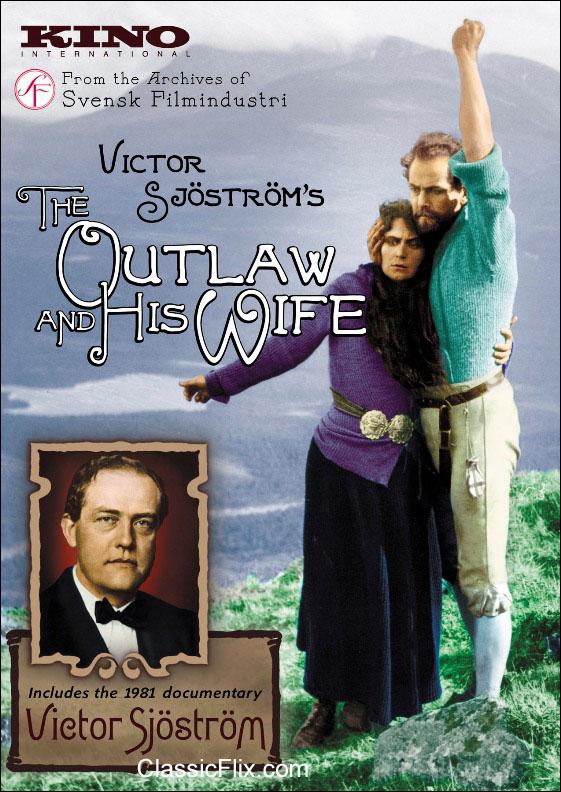
The Outlaw and His Wife (1918)

Standard

Director: Victor Sjostrom. Svenski Filmindustri.

SILENT


Producer: Charles Magnusson.
Camera: Julius Jaenzon.

Victor Sjostrom, Edith Erastoff, John Ekman, Nils Arehn.

SYNOPSIS

Iceland, mid-18th century: Strapping stranger Eyvind (Sjostrom) rocks up at wealthy widow Halla’s (Erastoff) farm one day. She immediately takes a liking to him, much to the consternation of her courtly brother-in-law (Arehn) who proposes marriage to her so he can grab her land and money. She refuses as she is interested in the stranger but Arehn is sure this new man is a fugitive on the run for stealing. Sure of his innocence, Halla believes Sjostrom’s story that it was an innocent one-off and he isn’t a career criminal, but to secure their romantic future together, they go on the run and live as outlaws in the hills. That is until Arehn, who never forgets a slight, finds out where they are hiding.

REVIEW

Director Sjostrom, also known as Seastrom during the American phase of his career in the 1920’s, is more famous for his work in front of the camera during his twilight years, starring in two films for the even more renowned Swedish auteur Ingmar Bergman, To Joy in 1950 and Wild Strawberries (1957).

It was this latter movie that he is most identifiable with, but he had a much longer career, stretching back to the days when Scandinavian cinema was in its infancy, a cinema that he would help to develop and define.

He also occasionally starred in his own films, like this frigid Western, more of a ‘Northern’ given the locale and was sometimes paired with his soon to be real-life wife, Erastoff.

Sjostrom’s pastoral dramas were progressive for the time in that the wild and rugged landscapes reflected or exemplified the harsh story lines and conflicted emotions of his characters. Iceland’s rough tundra and grassy hills, covering the bare and cold rock underneath, pre-empt the tragic path that the narrative will take. Our two lovers are unable to escape their past; Eyvind cannot, as much as he tries, cover-up his previous mistakes. The land becomes an unwelcome third person in this relationship, envious and spiteful, also represented by Eyvind’s lonely friend (Ekman) who lives with them but lusts after Halla and plots his pal’s death.

Some of the naturalistic scenery is awesomely captured on film and must have been an invigorating sight at the time to movie goers, with crisp waterfall showers and dizzying cliffs that dwarf the humans.

Sjostrom also is sexually liberated enough to inject a risque set-up to Halla’s homestead arrangements. Her farm is staffed almost exclusively by young burly men who compete with each other on manual tasks to impress her. Eyvind secures himself a position by besting all of them with a task of strength, leaving us in no doubt about what this merry widow has in mind for him.

In this regard, Erastoff is something of a revelation. Long since forgotten by film scholars and enthusiasts (she essentially retired from the screen after marrying Sjostrom in 1922), she is passionate and emotion-led, expressive and dramatic with a slightly wild look in her eyes as she buys Eyvind new bed blankets presumably to keep them both warm, baits him into wrestling her pompous brother-in-law to destroy that man’s masculinity and then promptly throws him out when he won’t marry her.

Sjostrom’s films have a tendency to focus on sad little marriages blighted by the cruel hand that circumstance and outside prejudice deals them. Such as the drunken men who disappoint their women in The Phantom Carriage, 1921, Lillian Gish and Lars Hanson as the hounded adulterers in The Scarlet Letter, 1926 and Gish and Hanson again enduring a forced marriage in The Wind, 1928. This is no exception, though being silent cinema we progress through a series of extremes. Such is the depth of their love, outside forces lead these two into murder, infanticide, poverty and madness.

As a side note, one of the most impressive scenes is of Sjostrom’s character dangling from a rope on a cliff edge and having to be pulled up. He performed this himself (with a safety line, out of shot) and nearly died when, just as he got to the top, an over-excited assistant let go of the safety line to embrace him.

Herr Arnes Pengar/Sir Arne’s Treasure (1919)

Standard

Director: Mauritz Stiller. Svensk Filmindustri.

SILENT


Producer: Charles Magnusson.
Camera: Gustav Boge, Julius Jaenzon.
Music: Matti Bye, Fredrik Emilson.
Sets: Axel Esbensen.

Richard Lund, Mary Johnson, Axel Nilsson, Erik Stocklassa, Bror Berger, Hjalmar Selander, Concordia Selander, Wanda Rothgardt, Gustav Aronson, Jenny Ohrstrom-Ebbesen.

SYNOPSIS

In the early 16th century, three Scottish mercenaries led by the young Sir Archie (Lund) escape from their Swedish captors and cause havoc in the local countryside as a vicious winter storm envelops the land. Famished, they chance upon a local vicar Arne (Selander) who is said to possess a large chest of silver coins. They kill him and his family, apart from his beautiful adopted niece Elsalill (Johnson) who hides from them. Sometime later, a distraught Elsalill is taken in by friends of her dead family and is romanced by Sir Archie, who hides his true identity from her.

REVIEW

Stiller was one of two preeminent directors of early Swedish film who helped in no small part to put Scandinavian cinema firmly on the movie map. Whereas his better remembered peer Victor Sjostrom’s oeuvre focused on small, intimate pastoral drama, Stiller concentrated on epic, moralistic action films or sophisticated comedies.

His films are marked by a more lavish and playful style (we open the film with the mercenaries leap-frogging over each other to get a guard’s attention) with an emphasis on technical innovation. Herr Arnes Pengar is no exception, with commendable use of mobile camera in several scenes, impressive  visual effects of ghosts communicating with the lead characters and the stunningly filmed finale, in which Elsalill’s mourners clad in funeral black snake their way across a frozen sea to reclaim her body. This particular moment is still breathtaking nearly a hundred years on and influenced other film-makers, such as Erich von Stroheim.

This is a downbeat film, with an emphasis on premonition – the spectral faces of the future haunt Arne’s wife who correctly predicts their part in her family’s downfall. Faces from the past dog those in the present too, as the ghost of Johnson’s adopted sister Berghild spurns her into vengeance whilst also taunting Archie, the man who killed her. Past, present and future are not dissimilar in Stiller’s tale and melt into and out of each other with a bloody, unrelenting fluidity. Even one of the character’s dogs is called ‘Grim’ as if to further underline the depressive elements of the story.

Johnson is a pretty and mournful heroine in a draining turn. She is a lover stricken with Post Traumatic Stress Disorder, brooding for a slaughtered family, contemplating an awesome suicide to stitch up the killer she has fallen in love with. This is a subtly powerful piece of acting, delicately delivered, making the emotional punch hit harder.

Lund, an important early romantic lead in Swedish film, also scores with a level-headed performance as the vicious thug redeemed by a good woman.

There are the usual silly, silent movie things that defy belief: Sir Arne might not be the smartest vicar in the parish if he leaves his treasure chest out for all to see. For Elsalill to not put two and two together that the trio of mysterious new men in her neighbourhood might be linked to the three men who killed her family a week previous is a crime in itself, but grief affects us all in different ways.

The spine-tingling score creates just the right atmosphere for a chilling story that is miles away from the first bawdy scenes we are given of soldiers larking about. This is a thriller in all but name and the music complements the murders and duplicity on screen.

UK movie releases…from 6 August 2013

Standard

Ain’t Them Bodies Saints – escaped convict Casey Affleck attempts to reunite with wife Rooney Mara and the daughter he has never met in this romantic crime thriller from David Lowery. The official Facebook page is here and the film will be playing at key cities only, so check the listings at your local art house/indie cinemas or the very big multiplexes.

Any Day Now – Alan Cumming and Garrett Dillahunt are the late-1970’s gay couple who take in a young man when his mother disowns him. But the legal system has issues with this unconventional family set-up. The official Facebook page has a listings section here as the film will show at only a few cinemas nationwide.

The Great Beauty – intriguing Italian drama in which a wealthy bon vivant reassesses the futility and hollowness of his hedonistic life when someone informs him of the death of his first love. The official Palace Films website is here; the film will be showing at key cities only.

The Great Hip Hop Hoax – documentary telling the story of two aspiring hip hop artists, signed by Sony who in fact turn out to be Scottish teenagers reinventing themselves as stateside homies. The Vertigo Films site is here; the film will be playing at key cities only.

More Than Honey – a timely documentary, given recent media coverage about declining bee populations, this film looks at what could have caused the various species of bee to be almost completely wiped out over the past 15 years. The official website is here and the film will show at key cities only.

Museum Hours – a bit like Night at the Museum…with brains. A museum curator in the Netherlands strikes up a friendship with an enigmatic visitor, leading to a crossroads that sees them exploring their lives and the art works. The official site is here; the film will show at key cities only.

No One Lives – As finite a title as you could hope for, this is a horror in which a couple in a car are kidnapped by a gang of ruthless thieves. There is, of course, more to the couple than meets the eye. The official Facebook page is here, the film will show at key cities only.

Pieta – Korean drama about a loan shark who re-evaluates his violent lifestyle when a mysterious woman appears claiming to be his long-lost mother. The official Draft House Films website is here; the film will be on a limited run only.

The Stuart Hall Project – The BFI screen John Akomfrah’s documentary about the titular founding figure of Contemporary Studies and a key figure in the New Left. The BFI’s website here tells you the screening locations.

uwantmetokillhim? – drama that looks at the true story of a teenage boy who kills someone after falling for a woman he meets in an internet chat room. Starring Downton Abbey’s Joanne Froggatt as the policewoman trying to make sense of it all. No official website but Wikipedia has a few more details here. The film will be showing on a limited release only.


The Way, Way Back (2013)

Standard

Directors: Nat Faxon, Jim  Rash. Sycamore Pictures/Walsh Company/OddLot Entertainment/What Just Happened (12A)

COMEDY


Producers: Tom Walsh, Kevin J. Walsh.
Writers:  Nat Faxon, Jim Rash.
Camera: John Bailey.
Music: Rob Simonsen.
Sets: Mark Ricker.

Steve Carell, Toni Collette, Allison Janney, AnnaSophia Robb, Sam Rockwell, Maya Rudolph, Liam James, Rob Corddry, Amanda Peet.

SYNOPSIS 

Shy and awkward teenager Duncan (James) is happy on the outside, preferring to hang around his Mother’s (Collette) apartment rather than mixing with his peers. That all changes one summer when they go on holiday with her over-bearing boyfriend Trent (Carell) who delights in denigrating and emasculating him. A chance bike ride to the local water theme park and meeting manager Owen (Rockwell) and his dysfunctional staff sees him getting a summer job that will change his outlook on life forever.

REVIEW

Just as the British summer ends (and it’s been a great one for once), the indie side of Hollywood gives us a blissfully funny holiday comedy to help ease us into the winter months. This is a film to settle into your sofa, possibly nestle into a loved one, and wait for the belly laughs to spring forth.

A slow-burner, you’ll probably want to walk out of the theatre during the first 30 minutes as we concentrate on getting to know some superficially horrible people in a serious family drama. This first third of the film is protracted a little too much to engage you as enjoyable character developement.

It all seems to going way, way back to nowhere until James meets Rockwell and the film suddenly jumps to life.

The comedy scores because it comes not from crudity or big pratfalls and slapstick action, but from the warm and inoffensive humour of the characters and their sweetly idosyncratic selves. The jokes can be a little silly, but are never immature, offensive or bodily part/function oriented. Quite a refreshing change considering the tone of most American blockbuster ‘laugh’ fests.

Rockwell has the best part as an adult who, if he wasn’t such a showman,  is so laid back he would be in a coma. He is the focus of the kind of chilled laughs the film-makers are aiming for, but the film works on this level because of the quality of the ensemble acting as a whole. Apart from Janney, Collette is an affecting dramatic foil as an eternally hopeful romantic, Carell is quietly impressive as her manipulative, covert agressive lover, Rudolph as Rockwell’s patient girlfriend and especially Janney as the piss-head neighbour being a notable exception and forming the bridge to the laughs to come, her loud and indiscreet dialogue about her son’s lazy eye providing a delicious levity.

At the centre of these breezy larks is James, who is a little revelation as the directionless teen who finds a voice. It’s a performance that quietly impresses and the little things are actually what you notice most about this turn, such as the hunched over shoulders, jerky walk and difficulty maintaining eye contact for long. He’s the very embodiment of every shy and retiring teen boy, a champion of the hormonally challenged.

UK movies release…30 August 2013

Standard

Bonjour Tristesse – Otto Preminger’s 1950’s comedy in which Jean Seberg tries to derail her Dad David Niven’s new romance with Deborah Kerr gets a new run in key cities thanks to Park Circus. The official Park Circus page is here.

Hammer of the Gods – Viking epic in which a dying Viking king sends his son on a quest to seek the clan’s last hope for stopping an approaching enemy horde. The film will show at key cities only and the official site is here.

Pain and Gain  – Transformer maestro Michael Bay tries his hand at comedy, although as those sci-fi films were so laughably bad, one could say a thread of humour runs through his films anyway. This is apparently based on a true story of three Miami personal trainers who steal a lot of money from a criminal, in pursuit of the American Dream of course. The film will be showing nationwide and the official website is here.

Plein Soleil – the French version of The Talented Mr Ripley (1999) stars the impossibly good looking Alain Delon in the Matt Damon role, a chancer who insinuates himself into the life of socialite Maurice Ronet and his girlfriend Marie Laforet. The film will play at key cities only so check your big city Art House cinema websites.

Upstream Colour – resoundingly great reviews across the board for this most uniquely visual of films. The IMDb plot summary is fantastically prosaic: ‘A man and woman are drawn together, entangled in the life cycle of an ageless organism. Identity becomes an illusion as they struggle to assemble the loose fragments of wrecked lives.’ Worth seeing just to unravel such a mystery. The official website is here; the film will be showing at key cities only.

And on Monday 2 September…

Cherry – Kyle Gallner is the freshman geek who dates a woman and her 14 year old daughter whilst at College in this sparky looking comedy from 2010. The official site is here; the film will be on a limited release.

And on Wednesday 4 September…

About Time – groan. The name Richard Curtis above a film title usually means a smug, sarcastic and generally unfunny time will be had by the viewer. Brendan Gleeson’s real-life lad Domhnall plays a man who can relive his past, so uses this unique ability to woo and woo again Rachel McAdams. The official website is here; the film will show throughout the UK.

Riddick – Vin Diesel must be short of inspiration to prop up his floundering career, with this third installment in the outer space saga that began with the inventive Pitch Black (2000). His titular anti-hero finds himself again on a scorched planet and again having to fight aliens so he sets of a beacon for help…but the mercenaries who land to meet him aren’t exactly friendly. Pitch Black‘s director David Twohy returns behind the camera here so the wide distribution deal might just save Diesel’s box-office skin. The official website is here.

The Red Shoes (1948)

Standard

Directors: Michael Powell & Emeric Pressburger. The Archers. (U)

MUSICAL


Producers: Michael Powell, Emeric Pressburger.
Writers: Emeric Pressburger, Keith Winter, Michael Powell.
Camera: Jack Cardiff.
Music: Brian Easdale.
Sets: Hein Heckroth.

Moira Shearer, Anton Walbrook, Marius Goring, Robert Helpmann, Esmond Knight, Albert Bassermann.

SYNOPSIS

Vicky (Shearer) is a talented young ballet dancer offered the chance of international success with a ballet company owned by Lermenotov (Wolbrook). She falls in love with composer Julian (Goring) who writes an opera called The Red Shoes specifically for her. But Lermenotov, who owns the copyright to the piece, is jealous and sacks Julian. Vicky leaves to marry to him but has to choose between love and arts as Lermenotov refuses to let anyone dance The Red Shoes, even beloved Vicky.

REVIEW

Based on a story by Hans Christian Anderson, this is one of the rare instances of ballet being produced for film, though Powell and Pressburger would make one more themselves, The Tales of Hoffmann in 1951.

This was a huge box office hit at the time, making more than 10 times what it cost to make internationally. Watching it nearly seven decades on, it beggars belief as to why.

One would expect that a filmed ballet might be a little slow to get going, perhaps drag it’s pointed toes somewhat, but it is not unreasonable to assume that directors of the calibre of Powell and Pressburger could have given us more than just a peep at the goings on behind the stage curtains.

This is a clear case of, as Mr Burns noted in an episode of The Simpsons ‘Too much prancing, not enough dancing!’, even though it is fascinating to peek into the preparation and perspiration poured into a ballet performance. From one who did a small amount of ballet toning/stretch classes in the past can attest to, it’s a physically punishing and mentally challenging art to grapple with, with many names for many different movements to remember and perfect.

We get beneficial insight into this and are able to get a good grasp of the dedication that Vicky has to climb her way to the top. Sadly, the real reason why one chooses to watch The Red Shoes is cast away and almost forgotten; to see ballet itself.

There could have been some actual dancing rather than rehearsal to break up the yawn inducing longueurs, a plie or arabesque, as least a half pirouhette. But no, all we get is stretching, mincing, bitching and then poncing (off to a cardboard Monaco to get married) until The Red Shoes are unboxed for our delight.

And what a thrilling spectacle it is! Choreographed by the celebrated Australian dancer Helpmann (who appears here as Ivan Bolesawsky), it’s a creepy, dazzling and frenetic affair, as if the Brother’s Grimm took up classy musical theatre with accompaniment by Sigmund Freud. It also allows them to show-off their formidable technical wizardry.

It allows Shearer the chance to finally show-off her extraordinary physical strength and talent, for she is no actress and has trouble holding up such a major production with only that straight back, those enviable deltoids and elegantly muscular thighs. Perhaps her vacuity explains the film’s soggy start. Her dancing certainly explains why the last section explodes with energy and passion. It’s just a shame our appetites aren’t whetted more along the way toward this fantastic moment.

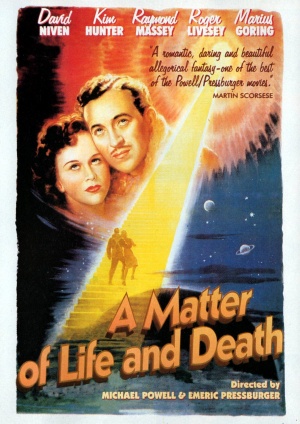
A Matter of Life and Death (1946)

Standard

Directors: Michael Powell, Emeric Pressburger. The Archers/Eagle-Lion/Universal. (U).

ACTION/ADVENTURE/FANTASY


Producers: Michael Powell, Emeric Pressburger.
Writers: Michael Powell, Emeric Pressburger.
Camera: Jack Cardiff.
Music: Allan Gray.
Sets: Alfred Junge.

David Niven, Roger Livesey, Raymond Massey, Kim Hunter, Marius Goring, Abraham Sofaer, Robert Coote, Joan Maude, Kathleen Byron, Bonar Colleano, Richard Attenborough.

SYNOPSIS

During WWII, British bomber captain Peter Carter’s (Niven) plane is hit by enemy fire killing his crew. In the final minutes as he crashes, ground crew Wren Joan (Hunter) picks up his distress call and the two fall in love as he narrates his last words. Bailing out suddenly, he somehow survives when he should have died, leading him to plead his case to remain living in a celestial court, watched over by a jury and observers of the great and the good of history.

REVIEW

Powell and Pressburger collaborated on a series of lushly vivid technicolour fantasies from their Archers Studio in London during the 1930’s – 1950’s, very nearly taking on Hollywood at its own game with lavish melodramas. This rumination on the meaning of being alive, also called Stairway to Heaven in the states, is one of the most glittering examples of their genius.

A vast film in scope, ambition and design we open appropriately on a map of the galaxy with the narrator informing us “This is the universe. Big, isn’t it?”. The understatement to end all understatements.

But Powell and Pressburger were able at this point in their conjoined careers to conjure up the most extraordinarily realised fantasy realms on celluloid, usually helped by gifted cameraman Cardiff.

Fog banks roil protectively over a little England, vivid red beacons pulse behind Hunter as she desperately engages Niven in life-saving conversation, the consuming orange of the fire in his plane throbs around him and later and most especially the eye-popping sets for a black and white heaven, including a mighty silver escalator to judgement in the most Godly and palatial of courtrooms. No need for grecian columns here, so full plaudits to designer Junge for realising this most impressive of astronomical architecture. He also reflects the humour of the writers be endorsing their view of heaven as a friendly but officious monochrome idyll, where bottles of Cocoa Cola are freely available from vending machines on arrival.

The visual style can be seen throughout with some neat trick shots: Niven goes under anaesthetic and we see from the inside his eye lid closing slowly in all it’s criss-crossing blood vessel glory. A psychadelic bloodstream then leads us back to his heavenly courtroom trial. Later, he and Conductor 71 (Goring) observe his surgery and casually pass through some doors.

There is an almost thrilling use of close and mid-close up throughout, particularly during the opening scenes as Niven and Hunter commence their courtship over the air waves, shockingly escalating the closeness of their conversation. Cardiff was one of the greatest cinematographers in cinema history and cleverly utilises the shadows cast by set props to isolate parts of Hunter’s face to embellish this approach, focusing on her eyes, nose and mouth.

The lush and overwrought aspect of the film is complemented in the intense and fevered performances of the cast, particularly Niven who was never more sincere or earnest as he innocently pursues wide-eyed military miss Hunter.

Better still are the legal defence he employs to cast him back to his temporal place, British Livesey (a P&P regular) and American star Massey as an Independence War hero, who memorably argue with each other about the faults of each nation and battle for Niven’s soul. As a mark of the esteem these film makers were held internationally, when Massey was offered the potential of a role in this film he remarked immediately to the producers, “For The Archers anytime, this world or the next.”

Oh dear though, for all this beauty, there is also ugliness. For the sensibilities of this era we have to suffer the appalling vision of racial segregation. Nurse/angel Byron notes at the beginning of the film that heaven is reserved for all “whether black or white, rich or poor”, but all of the black soldiers who have died during the war efforts are seated on their own, in tonal contrast to the Puritans and French revolutionaries around them.

But this is to see a film through the prism of 70 years earlier with the full benefit of today’s Equality and Diversity aware eyes. We can then feel some justice that when Livesey asks for a new jury of entirely American people, he gets American’s of every creed and colour.

Right down the cast list is a very young Attenborough, almost unrecognisable with a full head of hair.


Elysium (2013)

Standard

Director: Neill Blomkamp. Tri Star/Alpha Core/Media Rights et al (15)

SCIENCE FICTION


Continue reading