Film review by Jason Day of the silent film Variete/Variety starring Emil Jannings and Lya De Putti. Directed by E.A. Dupont.
Silent



Film review by Jason Day of the silent film Variete/Variety starring Emil Jannings and Lya De Putti. Directed by E.A. Dupont.
Silent

Director: Clyde Bruckman. Metro/Buster Keaton Productions.
COMEDY
Producers: Buster Keaton, Nicholas Schenck.
Writers: Jean Havez, Joe Mitchell, Clyde Bruckman.
Camera: Elgin Lessley, Byron Houck.
Sets: Fred Gabourie.
Buster Keaton, Kathryn McGuire, Jo Keaton, Erwin Connelly, Ward Crane.
A movie projectionist (Keaton) who is also studying to be a detective in his part-time, finds himself wrongly accused of stealing a watch. Returning to his full-time job, he falls asleep during the latest romantic blockbuster and imagines himself and the girl he loves (McGuire) are transported into the movie to play the characters on the silver screen. Comic mayhem ensues.
In Seven Chances, a lawyer (Keaton) finds he has been left a large amount of money in a distant relative’s will – payable on condition he marries, by 7pm that evening. Easier said than done when none of the society girls he approaches do anything other than laugh at him.
I would never usually combine two film reviews into one, preferring to let every individual movie stand on its own. But it seems appropriate here. Not to diminish the quality of Keaton’s comedies as stand alone pieces, but as both here cover similar ground thematically, comically and in terms of construction, this seems a neat and tidy approach.
Of the two film’s recently shown at Stratford Picturehouse courtesy of The London Screenstudy, Sherlock Jr. is the more famous and certainly the funniest. Seven Chances suffers from a protracted and dull opening that includes a disposable, two-tone technicolour sequence chronicling how Keaton, as every season of the year approaches, cannot profess love for his woman. It doesn’t help that the colour is of the poorest quality, almost as if it was hand-tinted by employees of the Georges Melies’ movie factory back in the very early days of cinema. The crudely drawn black characters (sometimes portrayed by white actors in black face) are more disturbing. Once comfortable in your seat, you will find yourself cringing and shifting from side to side to shrug off such sensibilities.
But back to Sherlock and Arthur Conan-Doyle himself may have giggled with delight in the cinema at the delightful and raucous send-up Keaton and co. made. Sherlock shows how sophisticated Keaton’s films had become in the short-time he progressed from two-reel comedies (a reel relates to approximately 10 minutes of film, the amount of stock in a film reel at this time) to feature films, the last of his series of short films being only one year previous (he would make one more silent short in 1925).
The use of the framing device (the ‘film within a film’), which can be a clunky addition if handled by a director merely seeking artistic kudos, is ingeniously utilised in a short segment when Keaton jumps into the screen. Initially, he is booted out again by the film’s leading man, but he perseveres and we are treated to a segment that contains some of the smartest trick editing on the silent screen. Caught between cuts to different locations, he is allowed no rest by the medium he is trying to hijack and is thrust into arctic tundra, rocky outcrops and manicured gardens. Cinema has no respect for this man who toils for it.
The framing device also allows Keaton to satirically explore the beauty and unpredictability of the cinematic medium, playing with the notion of what is real and what is illusion (he replaces the film’s leading actors with people in his ‘real life’ and as he swims to freedom in the film, we then cut seamlessly to him as the sleepy projectionist sat on a stool, ‘swimming’ whilst seated).
Sweetly, the projectionist even needs tips from his on-screen peers for help with wooing and kissing his girl. Sherlock Jr. may be a comedy, but it is an ideological and technical stride ahead of the smartest films being made in France or the esoteric Russian montage school.
But let’s not forget the jewel in this little crown that is the comedy – both film’s culminate in the most extraordinary manner, a crescendo of increasingly dangerous and clever stunts. Keaton’s background working with circus performer parents is clearly in evidence here as well as his athleticism at, for instance, dodging falling boulders as well as hundreds of eager spinsters (the ‘all the single harridans’ number in Seven Chances). The staging of these scenes, particularly in Seven Chances, is eye-poppingly impressive but given how you almost need to catch your breath as each moment passes to the next, it also shows how he his talent could run away with itself if left unchecked.
Keaton is undergoing a mini-renaissance at present, with the BFI holding a season of his films. Clearly there is no need for reappraisal, but to give modern audiences the chance to enjoy his artistry again.

Film review, written as an archive newspaper article, of the silent expressionist classic about a mysterious doctor associated with a travelling carnival and a spate of murders.
To like this review, comment on or to follow this blog, please scroll to the bottom of the page. Use the search function on the right of the screen to look for more reviews.
Director: Robert Wiene. Decla.
Silent


Director: Robert Wiene. Decla-Bioskop AG.
SILENT

Producer: Erich Pommer
Writer: Carl Mayer.
Camera: Willy Hameister.
Music: Larry Marotta (reissue).
Sets: Walter Reimann, Cesar Klein
Fern Andra, Hans Heinrich von Twardowski, Ernst Gronau, Harald Paulsen, Albert Bennefeld, John Gottowt, Lewis Brody.
SYNOPSIS
The subject in a painting about a high priestess of yore comes to life and escapes when the withdrawn artist who created her falls asleep. She is bought and then locked up, but released, only for murder and mayhem to follow. Eventually, the protagonists round up local villagers to try and contain this wanton apparition.
REVIEW
After such an auspicious push to his career with Das Kabinet Des Dr Caligari/The Cabinet of Dr Caligari (1919) director Weine, having hit an artistically and thematically lucrative seam (as well as a cheap one), quickly felt how the laws of diminishing returns can come to roundly trounce on one’s new found success.
This was his follow-up to that well-received first dip into expressionist cinema, in which the outside world is wildly distorted to represent the inner thoughts and motivations of the characters or story. This time around the expressionism in the design, performances and story is odd and jaunty, rather than being genuinely creepy.
The purple tinted screens are really vivid and the lighting is clever, using the shadow of a Max Shrek-like characters to look like Nosferatu. But this time around, the idea to save money by inventingly designing the sets on canvas backdrops in place of wooden, look just cheap and an odd pick and mix of imagery is used rather than forming part of a coherent production design.
Andra turns in a briefly silly performance as the title character. The nods to the expressionist style are there as she stretches her hands to the sky on seeing the ladder that will help in her escape, ages before she needs to actually start climbing. She’s gone a bit wild in a past life, which explains the crazy hair do. The rest of the acting confirms to the type of overly histrionic and mad gestures one would get in such a film of this period.
Maroletta provides a new, appropriately bleak score.
Perhaps Wiene’s trick film it seems was of the one pony kind.
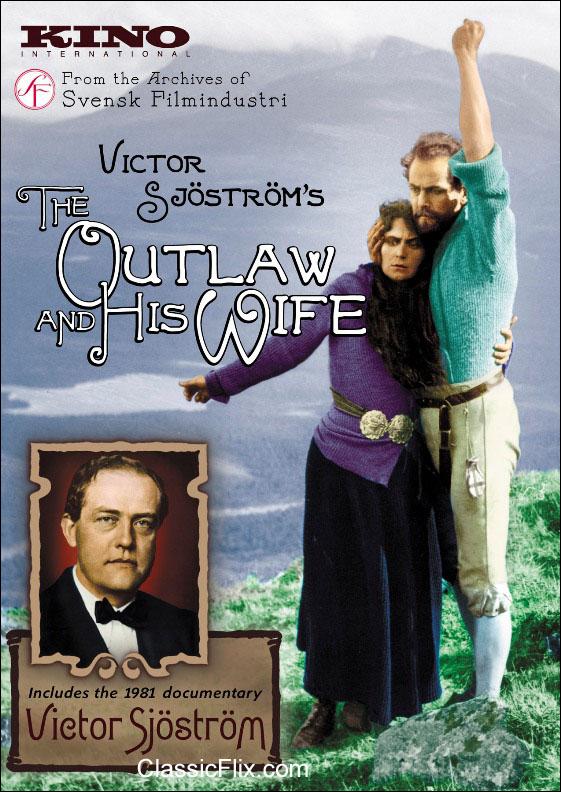
Director: Victor Sjostrom. Svenski Filmindustri.
SILENT

Producer: Charles Magnusson.
Camera: Julius Jaenzon.
Victor Sjostrom, Edith Erastoff, John Ekman, Nils Arehn.
SYNOPSIS
Iceland, mid-18th century: Strapping stranger Eyvind (Sjostrom) rocks up at wealthy widow Halla’s (Erastoff) farm one day. She immediately takes a liking to him, much to the consternation of her courtly brother-in-law (Arehn) who proposes marriage to her so he can grab her land and money. She refuses as she is interested in the stranger but Arehn is sure this new man is a fugitive on the run for stealing. Sure of his innocence, Halla believes Sjostrom’s story that it was an innocent one-off and he isn’t a career criminal, but to secure their romantic future together, they go on the run and live as outlaws in the hills. That is until Arehn, who never forgets a slight, finds out where they are hiding.
REVIEW
Director Sjostrom, also known as Seastrom during the American phase of his career in the 1920’s, is more famous for his work in front of the camera during his twilight years, starring in two films for the even more renowned Swedish auteur Ingmar Bergman, To Joy in 1950 and Wild Strawberries (1957).
It was this latter movie that he is most identifiable with, but he had a much longer career, stretching back to the days when Scandinavian cinema was in its infancy, a cinema that he would help to develop and define.
He also occasionally starred in his own films, like this frigid Western, more of a ‘Northern’ given the locale and was sometimes paired with his soon to be real-life wife, Erastoff.
Sjostrom’s pastoral dramas were progressive for the time in that the wild and rugged landscapes reflected or exemplified the harsh story lines and conflicted emotions of his characters. Iceland’s rough tundra and grassy hills, covering the bare and cold rock underneath, pre-empt the tragic path that the narrative will take. Our two lovers are unable to escape their past; Eyvind cannot, as much as he tries, cover-up his previous mistakes. The land becomes an unwelcome third person in this relationship, envious and spiteful, also represented by Eyvind’s lonely friend (Ekman) who lives with them but lusts after Halla and plots his pal’s death.
Some of the naturalistic scenery is awesomely captured on film and must have been an invigorating sight at the time to movie goers, with crisp waterfall showers and dizzying cliffs that dwarf the humans.
Sjostrom also is sexually liberated enough to inject a risque set-up to Halla’s homestead arrangements. Her farm is staffed almost exclusively by young burly men who compete with each other on manual tasks to impress her. Eyvind secures himself a position by besting all of them with a task of strength, leaving us in no doubt about what this merry widow has in mind for him.
In this regard, Erastoff is something of a revelation. Long since forgotten by film scholars and enthusiasts (she essentially retired from the screen after marrying Sjostrom in 1922), she is passionate and emotion-led, expressive and dramatic with a slightly wild look in her eyes as she buys Eyvind new bed blankets presumably to keep them both warm, baits him into wrestling her pompous brother-in-law to destroy that man’s masculinity and then promptly throws him out when he won’t marry her.
Sjostrom’s films have a tendency to focus on sad little marriages blighted by the cruel hand that circumstance and outside prejudice deals them. Such as the drunken men who disappoint their women in The Phantom Carriage, 1921, Lillian Gish and Lars Hanson as the hounded adulterers in The Scarlet Letter, 1926 and Gish and Hanson again enduring a forced marriage in The Wind, 1928. This is no exception, though being silent cinema we progress through a series of extremes. Such is the depth of their love, outside forces lead these two into murder, infanticide, poverty and madness.
As a side note, one of the most impressive scenes is of Sjostrom’s character dangling from a rope on a cliff edge and having to be pulled up. He performed this himself (with a safety line, out of shot) and nearly died when, just as he got to the top, an over-excited assistant let go of the safety line to embrace him.

Director: Arnold Fanck. UfA/Parufamet. (U)
SILENT
Producer: Harry R. Sokal.
Writers: Arnold Fanck, Hans Schneeberger.
Camera: Sepp Allgeier, Helmer Lerski, Hans Schneeberger, Arnold Fanck.
Music: Edmund Meisel.
Sets: Leopold Blonder.
Leni Riefenstahl, Ernst Petersen, Luis Trenker, Frida Richard, Friedrich Schneider, Hannes Schneider.
SYNOPSIS
Diotima (Riefenstahl) is an acclaimed dancer who lives in the Alps. She falls in love with Karl (Trenker), a reckless mountaineer and adventurer and the two become engaged. Karl’s best friend Vigo (Petersen), a young alpine sports competitor, develops a boyish crush on Diotima. Karl, on seeing them in a friendly embrace, mistakenly sees an affair and challenges his friend to a treacherous mountain climb. Vigo accepts and they head off into the dangerous weather conditions, Diotima chasing after them.
REVIEW
The extraordinary roller-coaster that was German cinema after the First World War and during the 1920’s encompassed the deranged, outward visual fantasies of Expressionism (The Cabinet of Dr Caligari, 1919), mammoth mythical epics from the Germanic past (Siegfried, 1924), slice of life realism ‘street movies’ (The Joyless Street, 1925) and movies such as this, the ‘Bergfilm’ (mountain film) which extolled the rugged, beauty of alpine nature and physical outdoor pursuits, a very German occupation.
The best of these were made by ‘Dr’ Fanck who made a series of these romantic dramas, most or all of which starred his repertory company of actors/stunt people such as Trenker, Petersen and Riefenstahl (more of whom later). The story is unabashedly simple, but narrative always took a back seat on the snow plough in Fanck’s films as the scenery, sports, heroics and comradeship were the focus.
He does create an interesting character in Diotima though. We need no titles to tell us that this woman is the embodiment of her surroundings. A raw and untamed sexuality, we first see her as a silouhette slowly appearing and almost merging with the landscape. Diotima is the land, air and water; her opening dance has her swirling on the coast, conjuring up a tempest as her movements become more energetic.
Fanck does not present his setting as some glittery, tinsle-strewn winter wonderland. The picture postcard beauty of the Alps is off-set by the violent nature of these environs, the increasing aggression of the weather clearly matching the heated emotions of the characters as the love triangle develops. There are swirling rivers , biting winds and deathly avalanches that not only shape the mountains, but also the lives of those who worship these hellish peaks. There are some lovingly filmed moments; Trenker imagining a mighty palace of ice as a home for him and Riefenstahl as he becomes delirious during a storm and the blue-tinted night time search party, lit by flares.
Fanck’s prologue explaining that there is no trick photography is no false claim, the daredevil skiing and mountaineering sequences were largely filmed on location and features the actual stars.
The performances are largely neglected, but Trenker makes a stout hero and Petersen’s throbs with the right sort of hormonally challenged enthusiasm. Riefenstahl was most certainly a better director than an actress and, given the fitful, epileptic dance she employs, a far greater actress than a hoofer.
Comfortably viewing with hindsight, this is a seductive but slightly dangerous film. One can pick out and analyse the calling cards of proto Nazism in the sweet symbolism. It is in fact difficult to divorce one’s thinking from going down that mountain path, particularly considering Riefenstahl’s later career as the most technically and artistically gifted film-maker employed during the Nazi regime, making a handful of documentaries that would propel and then destroy her career. But Fanck’s film still stays on the right side of the peaks, as an otherwise innocent fusing of the deep bond, respect and love between man and nature, a respect for our world that is mostly missing from modern cinema.
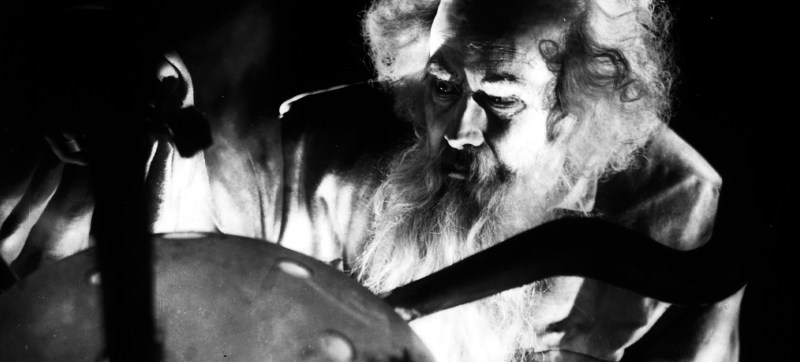
Film review by Jason Day of the silent epic from F.W. Mourn about an old man who sells his soul to the devil in return for his youth. Starring Gosta Ekman and Emil Jannings.
Director: F.W. Murnau. 106 mins. Parufamet (Paramount/MGM & Ufa).
Silent

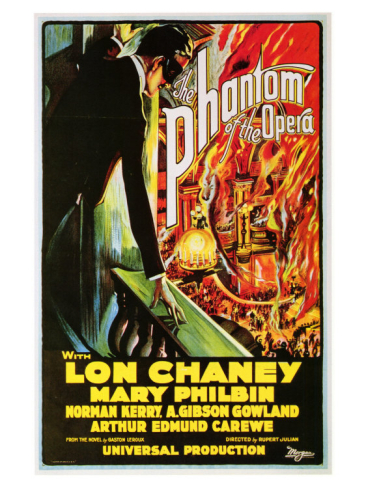
Director: Rupert Julian. Universal.
SILENT

Producers: Carl Laemmle. Writers: Elliott J. Clawson, Raymond L. Schrock. Camera: Milton Bridenbecker, Virgil Miller, Charles Van Enger. Music: Joseph Carl Briell, Gustav Hinrichs (original). Others at reissue: Sam Perry (1929), Gabriel Thibaudeau, Rick Wakeman (both 1990), Roy Budd (1993), Carl Davis (1996). Sets: Ben Carre.
Lon Chaney, Mary Philbin, Norman Kerry, Arthur Edmund Carewe, Gibson Gowland, John St. Polis, Snitz Edwards, Mary Fabian, Virginia Pearson.
SYNOPSIS
Erik (Chaney) is a former singing star, horribly disfigured now reduced to lurking in the vast underground catacombs and cellars of the Paris Opera House. He nurtures the talent of young chorus girl Christine (Philbin) whom by devious methods, he hopes to place in a production of Faust. He also wishes her to see beyond the mask that hides his tortured face and fall in love with him, but is enraged when she pursues her own love in handsome Raoul (Kerry) against his instructions. He kidnaps her so Raoul and a strange, undercover policeman (Carewe) attempt to rescue her.
REVIEW
Chaney’s second, bug-budget horror blockbuster after The Hunchback of Notre Dame (1923) is set in the same city and eagle-eyed silent movie fans will note that Chaney’s carriage at the end of the film is seen speeding past the facade of Notre Dame cathedral, a little in-joke for contemporary fans.
This is a slow-moving adaption of Gaston Leroux’s famous novel, with a tortuously prolonged opening as the Phantom crawls around a section of his subterranean lair, watched by an Opera orderly. The lack of action isn’t helped by the over-use of letters, constantly passed between characters, to describe action – clunky and effective only in slowing things down more.
Julian quarrelled on set with Chaney and was dismissed at some point during the production, which might explain the slightly unbalanced feel throughout, as if a few more hand than necessary were fingering the clapperboard. Chaney himself directed a few sequences.
Of what remains, there are some giddily enjoyable flourishes, such as the opening that uses a group of silly ballet dancers to set the mystery, as the girls twirl in their tutus around the dank staircases and cellars.
If the unmasking of the phantom is more funny that scary, the eye-catching multi-story sets of the Paris underground that is the phantom’s lair and the Masked Ball, filmed in a beautiful trifle of two-tone colour, more than make up for it. This last scene, lasting only a few precious minutes, would have increased the film’s budget somewhat, so it’s a shame it doesn’t last longer and whomever directed it didn’t have the time to have some more fun with the dancers.
Philbin’s strange, hyper-gesticulatory performance is richly rewarding, she acts as if constantly in a trance (her character is under the spell of her master, at least in her opening scenes). This is a hangover from the overly artificial turns in German films such as The Cabinet of Dr Caligari, but this is one to enjoy, slightly mad, but eye-catching (it helps that she is also extremely pretty).
Chaney seems possessed himself, though it could be as a result of what looks like excruciating prosthetics that push his nose up and give him gross, jagged teeth and a bald pate with lank, greasy hair. Every extreme physical stereotype of ugliness is utilised by Chaney, who designed the make-up.
The script is a typical silent blockbuster type of this period, slightly nonsensical and in dire need of a continuity editor. Christine, after being led by a strange man through the catacombs, talks at length to her master but, only after seeing the coffin he sleeps in, does she twig that this man might be the same person as the Phantom. He calls her mad – clearly having little insight into his own sociopathic tendencies (this is just after he has dropped a hefty chandelier on Paris’ hoi polloi).
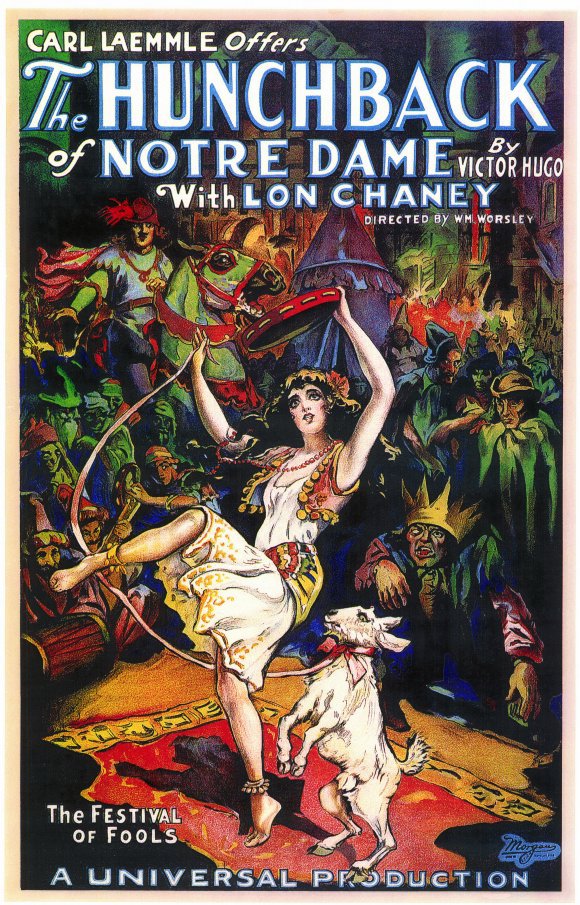
Director: Wallace Worsley. Universal.
SILENT
Producers: Carl Laemmle, Irving Thalberg. Writer: Edward T. Lowe, Jr. Camera: Robert Newhard. Sets: E.E. Shelley, Sydney Ullman.
Lon Chaney, Patsy Ruth Miller, Norman Kerry, Kate Lester, Winifred Bryson, Nigel De Brulier, Brandon Hurst, Ernest Torrance, Tully Marshall, Harry van Meter, Raymond Hatton.
SYNOPSIS
Paris, 1482: Set against the backdrop of growing public resentment at the laws and dictates of King Louis XI (Marshall), Quasimodo (Chaney) a deformed bell ringer at Notre Dame cathedral falls hopelessly in love with the beautiful Gypsy dancer Esmerelda (Miller). When Esmerelda is tried with the attempted murder of her lover, the soldier Phoebus (Kerry), he attempts to rescue her as revolution erupts beneath his beloved cathedral.
REVIEW
Caution, literary respect and a fair degree of common sense are thrown to the wind in the great grand-daddy of all adaptations of Victor Hugo’s mammoth and largely unexciting romantic epic (were all of those chapters about Gothic architecture really necessary?).
‘The Man of a Thousand Faces’ Chaney headlines as the poor, mis-shapen campanologist, though it is not one of his better turns.
The hasty editing, particularly in the horrifically rushed introductory scenes (possibly down to there being several versions of the film of differing lengths around the world – not uncommon for silent movies) leads to a large amount of information about characters, themes and sub-plots being whisked by the viewer in quick succession. Hugo’s book is a feat for any screen-writer to compress so it is probably not surprising that sections were skipped or skimmed over, but the irritating over use of title cards to sum up whole people and their motivations when this could have been expressed to the camera shows either poor directorial skills on the part of Worsley or nonexistent talent when wielding the scissors in the cutting room.
We also miss out on those subtle, telling aspects of the story, such as Quasimodo’s dependent relationship with his master Frollo, but the sound era would help rectify such things.
Another thing the sound era would help clear up, is that implausibility that silent movies tended to lean toward, those moments that don’t really make sense. Quasimodo, after being described as totally deaf and half blind, is immediately seen spying on the crowd assembled a hundred feet below and is able to pick out the people insulting him, as the bells of the cathedral ring behind him.
One thing Worlsey really misses a trick with are these crowd scenes. Later versions, including Disney’s animated go in 1996, use the crowd as an integral part of the story, as if it is a living organism, swelling en masse at various points with a fluid motion. Despite the alleged 3,500 extras used in this film, these moments seem empty, slightly scrappy, as if the man with the megaphone in his hand is whispering in the wrong direction.
On the acting front, and again to be democratic, it is difficult to see whether this a poor choice of cast (Miller and Kerry were never top flight actors of this period) or if Worsley was unable to elicit more innovative, subtle performances from his ensemble. Chaney is supposed to be the man of the moment here but his turn is on the edge of over melodramatic. He never really evinces true sympathy, though it doesn’t help that the titles spell him out as being something of a bad one, consumed with hatred for the citizens of Paris who despise his deformity (the novel and subsequent adaptations do not dwell on this).
There are some superb displays of villainy though; De Brulier as Don Claudio (Claude Frollo in the novel) is genuinely creepy and Torrance proves why he became one of the most famous of silent bad guys as Clopin, King of Thieves.
Pity poor Kerry though, who would spend most of the next six years playing second fiddle to Chaney (he would do so again in The Phantom of the Opera two years later and The Unknown in 1927).
Universal provide the means to an end to recreate Paris with a lavish eye, including the quick glimpses we get of the fetid underground sewers and Court of Miracles. This is described as a place where the blind see and the lame walk, rather like a medieval Atos assessment centre.

Film review by Jason Day of The Spanish Dancer, the silent film comedy romance starring Pola Negri and Antonio Moreno.
Silent

 CineSocialUK