Future movie releases…w/e 25 January 2013

Standard

Hollow – British horror starring Emily Plumtree about an abandoned monastery that lures young people to commit suicide. Wikipedia site is here but only having a limited release.

The Last Stand – Arnold Schwarzenegger makes his big screen comeback as a small-town Sherrif who takes on a big drug Lord (Eduardo Noriega) who happens upon his small town. Official UK site is here, showing nationwide.

Lincoln – one of the big hitters for this years awards season, this is Spielberg’s Civil War epic with Daniel Day-Lewis as the titular 1860’s President who must wrestle with political in-fighting as he struggles with his conscience to try and free millions of slaves in America. Largely tipped to win at least the big acting Oscars (Sally Field and Tommy Lee Jones are also nominated, but in the supporting categories) this has the sweep of a big film at least. Showing nationwide. Official site is here.

Movie 43 – Despite the massive social media profile employed to promote this comedy, still no official site. Looks like a massive portmanteau flick with Halle Berry and Hugh Jackman et al…no idea (or much care) about what it is about though. Showing nationwide. Facebook page is here.

Race 2 – I love how with Bollywood films when you try to find out what the plot is, even the Wikipedia and Facebook pages tell you next to anything! Essentially though, this is a Bollywood Fast and the Furious. Wikipedia site is here and this is showing at Key Cities only.

Won’t Back Down – Seems like every year brings a new failing inner-city American school drama. Here, Viola Davis and Maggie Gyllenhaal try to sort theirs out to improve their kids grades. IMDb site is here, showing at key cities only.

Zero Dark Thirty  – controversial US drama (director Kathryn Bigelow was, according to rumours, denied an Oscar nod for best director here because of this film’s graphic torture sequences), Jessica Chastain stars as the committed intelligence operative who is involved in the hunt for Osama Bin Laden. Official site is here, showing nationwide.

The Hobbit: An Unexpected Journey (2012)

Standard

Director: Peter Jackson. NewLine/Wingnut/MGM/3Foot7. (12A)

ACTION/ADVENTURE/FANTASY


Producers: Carolynne Cunningham, Peter Jackson, Fran Walsh, Zane Weiner.
Writers: Fran Walsh, Philippa Boyens,  Peter Jackson, Guillermo del Toro.
Camera: Andrew Lesnie.
Music: Howard Shore.
Sets: Dan Hennah.

Ian McKellan, Martin Freeman, Richard Armitage, Ken Stott, Graham McTavish, William Kircher, James Nesbitt, Stephen Hunter, Dean O’Gorman, Aidan Turner, John Callen, Peter Hambleton, Jed Brophy, Mark Hadlow, Adam Brown, Ian Holm, Elijah Wood, Hugo Weaving, Cate Blanchett, Christopher Lee, Andy Serkis, Sylvester McCoy, Barry Humphries, Kiran Shah, Benedict Cumberbatch.

SYNOPSIS

60 years before his nephew joined another fellowship, to destroy a magical ring that has the power to enslave all of Middle Earth, unassuming Hobbit Bilbo Baggins (Freeman) lives a comfortable, sheltered life in the beloved Shires. That is until the wizard Gandalf (McKellan) and a group of raucous dwarves (led by Armitage) show up on his doorstep. Bilbo is taken out of his comfort zone on an adventure to recapture the Dwarve’s fabled home city, taken years earlier by a ferocious dragon, encountering dangerous creatures and finding he has unexpected depths along the way.

REVIEW

Peter Jackson is a man who knows how to make big movies. Very big. Colossal in fact. And if he throws caution to the wind in terms of economy of scale, well good on him and so be it. What he is in dire need of however is a stopwatch. And a gutsier editor.

The combined length of his Lord of the Rings trilogy weighed in at around an arse-numbing nine hours (and that’s the slimmed down theatrical releases – there were extended versions released on DVD), King Kong concluded only after a rather unnecessary three hours plus. It is probably no surprise that he filmed so much footage for this adaptation of the first and singular novel in Tolkein’s Middle Earth series that it was easier to release it as another trilogy.

It also makes good box office sense; these films are expensive to make so two extra films means more box office ‘kerching’. It has also lead to an accumulation of rather a lot of protracted, repetitious, disposable events, scenes and moments in a film that runs to two hours 49 minutes in its original movie theatre version. The opening preamble, for instance, with the older Bilbo (Holm) and Frodo (Wood) seems tacked on to help audiences familiarise themselves with the first book being adapted last. Given the mighty publicity machine deployed though, the value of this scene is questionable.

One can’t help but imagine how much cheaper these film’s would be, if Jackson shaved half an hour off each one during the development stage.

Perhaps this feeling is wholly a question of taste at the end of the day; with nearly a $billion in gross takings for this first instalment as of Jan 2013, who am I to judge? But judge I will when I feel a creeping sense of the familiar and duplicated throughout.

I freely admit to not having read any of Tolkein’s much admired books. Perhaps I lack perspective on certain things, but as a film viewer and reviewer, it didn’t aid my enjoyment to come across settings already visited (the Dwarf city of Moria, where Gandalf was ‘killed’ in the first Rings film) and situations that smack of the ‘been there, seen it’ (the eagles who fly to the rescue, as in the second Rings film). This ‘samey’ feel probably explains why the London Evening Standard thought this was a ‘fair to middling return to Middle Earth’.

The set-pieces and special effects are, of course, magnificently realised. In terms of head-swirling spectacle, The Hobbit delivers in spades. 3D is used exceptionally well in many sequences, but if any film genre was made to be told in an extra dimension it is this. But this is par for the course; we know Jackson and his too-numerous-to-mention-individually technical team can deliver the goods here. He really needed a different tack to make this new trilogy stand out from it’s forbears.

The musical sequences are cute but a step in the wrong direction; are we heading into Cameron MacIntosh territory? Surely we want something other than Les Middle-arables. Could it be emotional intimacy in amongst the CGI? Are we hankering for less people but better character development?

Freeman is saddled with much of the dramatic weight of the film as his character is the main person who will progress and mature, but he is mostly sidelined until the film kicks into life (thank heavens we leave the Shire behind us). It will be interesting to see how far he pushes the next two films.

There are welcome returners in the cast, dotted amongst the newbies – Blanchett and Weaving as almost hypnotic Elvish leaders, Lee shows the beginnings of his turning to the dark side, Serkis is still unrecognisable as the dissociative Gollum. Of those new cast members who score strongest (or loudest at least), Nesbitt is Dwarf Bofur, Stott is older Dwarf Balin and former Dr Who McCoy makes a surprise cameo as a far too eco-friendly wizard (let’s just say it is no surprise he is known as ‘The Brown’). The dwarves help make sure that the comedy moments (such as when they are BBQ’d by two hungry trolls) carry the film along during the longuers. It’s a shame, then, that these are few and far between. Let’s hope that, as with the first part of Lord of the Rings, things pick up nicely after this lumbering character introduction.


The Impossible/Lo Impossible (2012)

Standard

Film review by Jason Day of Lo Impossible/The Impossible about the Boxing Day Tsunami starring Naomi Watts.

Disaster


Continue reading

Life of Pi (2012)

Standard

Director: Ang Lee.

DRAMA


Producers: Ang Lee, Gil Netter.
Writer: David Magee.
Camera: Claudio Miranda.
Music: Mychael Danna.
Sets: David Gropman.

Suraj Sharma, Irrfan Khan, Rafe Spall, Ayush Tandon, Gautum Belur, Adil Hussain, Tabu, Gerard Depardieu, Andrea Di Stefano.

SYNOPSIS

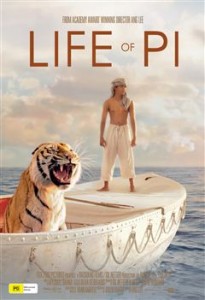
A strange journey awaits the highly intelligent and ever curious Pi (Sharma as a teenager, Khan as an adult) when his family emigrate from India to Canada, taking with them the creatures from their zoo that they will sell on arrival. A storm sinks their ship leaving Pi adrift on a lifeboat, the only survivor. That is, apart from a ferocious tiger, enigmatically known as Richard Parker. Recounting his ordeal as an adult (Khan), Pi learns to subdue the tiger and coexist with it, he not only finds how to survive his ordeal mentally but begins to understand what God is.

REVIEW 

A film to put you in a good mood, despite the admittedly arduous plot line. For me it helped that the showing I attended featured no trailers or adverts – so a thumbs up before the opening credits had rolled!

A difficult novel to film, but Lee shows his extraordinary intelligence as a film-maker throughout. It’s always arguable whether the framing device of having flashbacks from a character to his younger self is either a necessary tool to position the narrative or an irritating, disposable stylistic folly that can weigh down the ebb and flow of the piece, but Lee has made sure to avoid this pit-fall. The seamless editing for a start sees us gently taken from wistful recollection to storm tossed seas, using the ripple of water as an appropriate lap dissolve between the two.

A lifeboat set film doesn’t inspire a viewer with confidence in the action stakes (Hitchcock’s Lifeboat being a suspenseful exception), but the time whizzes by thanks to a number of carefully spaced set-pieces from the magnificent, balletic shipwreck (rendered with sea-sickness inducing reality), a phosphorescent humpback whale breaching over Pi’s little boat and the downright bizarre ‘Meerkat Island’ (try comparing this community!). The tiger is brought to roaring life by the best CGI technicians, but Lee’s main achievement on the mechanical side of this film is to correctly utilise the 3D technology to embellish his story, rather than to swamp it or use only occasionally for throw away spectacle.

Pi is an engagingly resourceful character at all points in his life, enhanced by the pitch-perfect performances of those playing him. Each is able to show the progression of boy to man but Sharma, with no previous acting experience to his credit, should take most of the plaudits as the Pi who is cast adrift, but never loses his way. Khan has the lion’s share of the laughs as a jovial adult Pi. Depardieu makes an unexpected cameo as a foul, racist cook who abuses Pi’s family and almost starves them. Spall has a sweeter supporting turn as the Canadian novelist who wants to turn Pi’s history into a book.

Forget reviews that point out the similarities to the deeper aspects of Yann Martel’s novel, that being an existential rumination on the nature and form of God. Lee has paid decent lip service to this side of the story and a rich vein of religious and self discovery pervades the film. But he has wisely chosen to make something of beauty and wonder, as much as about the world around us than of a higher power, rather than trying to create a cinematic theology lecture.

And the Oscar could go to…

Standard

Difficult to judge where the little tin/copper, gold plated men will go to this year as many of the contenders for awards (Lincoln, Zero Dark Thirty, Django Unchained, The Sessions) are yet to be released in the UK.

The next 3 weeks should see to that, so I will revisit this initial assessment but, based on what I’ve seen and Oscar’s own personal tastes, this is what I predict right now will win in the main four categories:


Best Picture – Lincoln. Friends in America have been none to impressed by this judging it to be long and dull, but the critics seem happy and it’s not as if a big Civil War epic hasn’t cleaned up before (ahem, Gone With the Wind).

Best Director – Steven Spielberg for Lincoln. It usually follows that the Best Director made the Best Picture. None of the other nominations, with the possible exception of Benh Zeitlin for the acclaimed Beasts of the Southern Wild would, in my mind, stand much of a chance. The other films are good, but Lincoln has that old style craftsmanship and tells a good political/moral that could tickle older Academy voters (according to this incisive investigation by the LA Times , the average age is 62) and see it through.

Best Actor – Joaquin Phoenix for The Master. This was a stunning turn. As much as I think Daniel Day-Lewis deserves it for Lincoln (and on the basis of the trailer, his performance is just as extraordinary), Phoenix is a revelation as the physical personification of a tortured, confused soul. Definitely not Hugh Jackman (Les Mis is a musical and musicals don’t usually win for the lead actor roles).

Best Actress – difficult one to call as the actresses here are all great. Oscar could be sentimental and give it to their oldest Best Actress nominee Emanuelle Riva for Amour but, Marion Cotillard aside as an anomaly French actress winning for speaking French in a French film, my money would be on Naomi Watts in The Impossible (tragedy, human interest – Oscar can still be sentimental).


Awards season kicks off – BAFTA Film nominations announced

Standard

Steven Spielberg’s yet to be released in the UK American Civil War biopic Lincoln leads the way at this year’s BAFTA Film awards with 10 nominations. The full list of nominees can be read on BAFTA’s site here.

And for the Oscars – stay tuned for tomorrow’s announcement.

Love Actually (2003)

Standard

Director: Richard Curtis. Universal/Studio Canal/Working Title/DNA Films. (15).

COMEDY


Producers:
Tim Bevan, Eric Fellner, Duncan Kenworthy.
Writer: Richard Curtis.
Camera: Michael Coulter.
Music: Craig Armstrong.
Sets: Jim Clay.

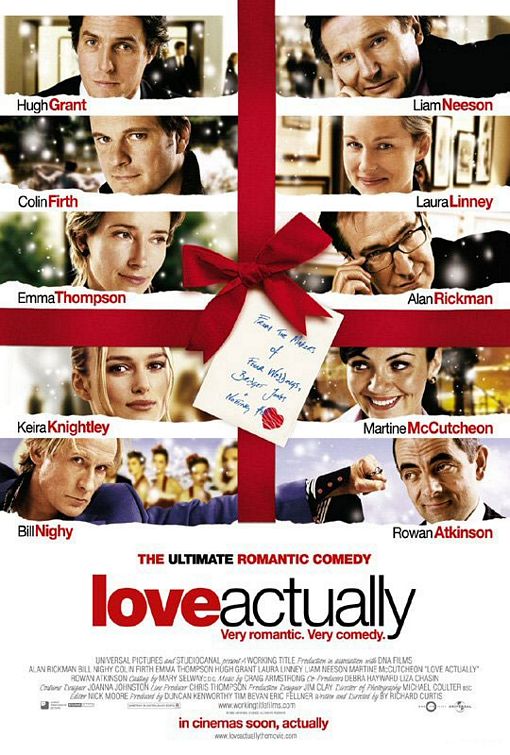
Hugh Grant, Liam Neeson, Colin Firth, Laura Linney, Emma Thompson, Alan Rickman, Keira Knightley, Martine McCutcheon, Bill Nighy, Rowan Atkinson, Gregor Fisher, Chiwetel Ejiofor, Andrew Lincoln, Kris Marshall, Martin Freeman, Joanna Page, Sienna Guillory, Rodrigo Santoro, Edward Hardwicke, Billy Bob Thornton, January Jones, Claudia Schiffer, Shannon Elizabeth, Denise Richards.

SYNOPSIS

The love lives of eight very different couples in London are chronicled in the run up to Christmas.

REVIEW

Largely successful, Brit-portmanteau picture that could have been titled Luvvies Actually given how much of Equity’s register has been emptied to fatten up the cast list.

Right at the top of the bill (and that has never been an indication of quality in such star-studded pictures) is Grant as a love-lorn and single Prime Minister chasing clumsy new tea-girl McCutcheon. This is a gormless and charmless pairing, Grant’s aggravating, stuttering bluster by now a cliche, a cinematic short-cut of performance. McCutcheon is a chirpy ‘cockernee’ sparra’. Well, what else would she be? Her post- Eastenders debut was never going to push expectations.

Such ego-heavy productions groan at the seams with performers ecstatically trying to out act each other. Oddly though, the turns that stick in the memory here are those that don’t try too hard. Neeson trying it on with thinly veiled supermodel Schiffer (ignore the awful child crowing them on), Rickman contemplates a mid-life affair encouraged by nice friend Thompson and there is a heartbreaking threesome in Knightley, Ejiofor and Lincoln. The denouement to this particular thread of the story is literally a wrench, brilliantly and shockingly delivered by these actors.

There are still more powerful turns. In terms of comedy, Nighy and Fisher score most strongly in the entire film. They feature as a washed up eighties pop star and his long-suffering manager, trapped forever in a sexually unfulfilling bromance. Nighy is given one last shot at music immortality with a fairly ropey Christmas single. There can be no greater satisfaction for a cynical British audience, in this part of the story at least, to hear him refer (to Fisher’s horror) to Ant and Dec as “Ant or Dec” and note to their audience of largely under 15 year olds: “Kids, don’t buy drugs. Become a rock star and people will buy them for you”. This has to be the best line that Curtis has ever dropped into a motion picture screenplay. Thank you Richard!

For drama though, take a bow Ms Linney. One of the handful of visiting foreigners in this film, she can hold her head up high that, on celluloid at least, she juggles a difficult storyline perfectly as a woman trying to placate a mentally unbalanced brother and maintain the interest of horny Brazilian colleague Santoro. She deserves an Oscar for managing to keep her hands off him. This is the most impressive straight performance in the whole film.

Atkinson, who shares Curtis’ love of the extended similie and that certain Oxbridge humour (they both worked together on the Blackadder TV series) ties elements of the movie together as an obsequious Department Store sales clerk in some ill advised pantomime, but the film still scores because the humour and feel-good factor are nicely balanced with believable festive angst.

Home Alone (1990)

Standard

Director: Chris Columbus. 20th Century Fox/Hughes Entertainment. (PG).

COMEDY


Producer:
John Hughes.
Writer: John Hughes.
Camera: Julio Macat.
Music: John Williams.
Sets: Dan Webster.

Macaulay Culkin, Joe Pesci, Daniel Stern, John Heard, Roberts Blossom, Catherine O’Hara, John Candy, Angela Goethals, Devin Ratray, Gerry Bamman, Kieran Culkin.

SYNOPSIS

Precocious 8 year old Kevin (Culkin) is accidentally left at home on his own during his family’s last minute rush to the airport for a Christmas break in Paris. As he struggles to fend for himself, two inept burglars (Pesci, Stern) attempt to break into his house. Ready for when they return, he sets a series of traps to protect his home.

REVIEW

A film that clearly puts into perspective what the true meaning of Christmas is: cute little kids burning other humans, smashing paint cans over their heads and generally hospitalising them in some indescribably cruel, but at the same time ‘hilarious’ manner. Ho! Ho! Ho! For ’tis the season to call social services?

Culkin went, very quickly, from being the most famous person on the planet to being almost persona non grata as possibly the most annoying child in the world. Despite showing resourceful charm and the cheeky resilience that made Jackies Coogan & Cooper and Shirley Temple into worldwide stars, he also shows the tipping point at which children in movies went from wide-eyed intelligence to smug, self-aggrandising know-it-alls.

Writer/Producer Hughes gave the world the ‘Brat Pack’ in the eighties so Culkin was his gift for the next movie generation (Thanks Unlce John!). He sits squarely away from the director’s chair on this occasion, handing over the reigns to Columbus, but his style is imprinted on every frame: kids in control, children as resourceful people, parents sidelined, broad slapstick comedy.

By this time the prolific Hughes, whose films had defined a decade, was receding more and more from public view (his last film as a director was the lamentable Curly Sue in 1991) but he could still churn out blockbuster hits, which Home Alone went on to become, incredibly spawning 4 sequels.

What Hughes was always a genius at doing was reducing his writing to the worldview of a child without ever patronising his key audience. Home Alone is probably the most grown up film for very young children he ever made, if you consider how uniquely independent Culkin’s character is, the intellectual and physical power he wields over the burglars trying to break in and the free reign he has over a dominion that is usually the sole preserve of the parent – the house. I can clearly remember, aged 11 when the film was first released, how completely jealous I (and a few of my classmates) were to see a peer fending for himself, fighting of the baddies and having a blast in the process.

It helps that what Hughes does is never once let us forget that the lengths Culkin’s character goes to to protect his home and possessions are only half believable. Exaggerated antics, but still rooted in the reality of what a child with very little concept of what pain is could do to someone with everyday household objects and a vicious imagination. That the ‘comedy’ in this slapstick house of horrors works is due in no small part to the fantastic orchestration by Columbus, the screenwriter of Gremlins (1984), who clearly was making a career at causing ultimate mayhem at Christmas. Columbus ensures that the ingenuity of Kevin’s revenge is never once ridiculous.

The other side of the coin that makes these sequences so guiltily enjoyable is in the playing of the villains by Pesci and Stern. These two deal admirably with the punishment meted out to them. Pesci would win the Best Supporting Actor Oscar for his work this year, but for a very different role in a markedly different movie, as the unhinged, unpredictable and foul-mouthed Tommy DeVito in Scorsese’s gangster epic Goodfellas.


It’s a Wonderful Life (1946)

Standard

Director: Frank Capra. Liberty Films/RKO (U).

DRAMA


Producer:
Frank Capra
Writers: Frances Goodrich, Albert Hackett, Frank Capra.
Camera: Joseph Biroc, Joseph Walker, Victor Milner.
Music: Dimitri Tiomkin.
Sets: Jack Okey.

James Stewart, Donna Reed, Lionel Barrymore, Thomas Mitchell, Henry Travers, Beulah Bondi, Frank Faylen, Ward Bond, Gloria Graham, H.B. Warner, Frank Albertson.

SYNOPSIS

George Bailey (Stewart) is a nice, compassionate guy. But one Christmas, the stresses of work and life get the better of him and he considers committing suicide. An angel-in-training (Travers), needing to gain his ‘wings’, visits him and shows him how poor life would have been for his family and local community if he had never existed.

REVIEW

Boo! Hiss! To the critic who dares to give this perennial American film favourite anything less than 5/5. But, in all honesty, you would have to be American to completely ‘get’ the whimsical schmaltz that pervades every frame of Capra’s lovingly remembered movie, loosely inspired by Dickens’ A Christmas Carol.

Not that it was so lovingly received at the time. It’s a Wonderful Life only broke even at the box office, though it’s high production costs probably added to it’s financial woes. Confidence in Capra as a director of high quality, populist, star-studded morality tales was so shaken after this he directed only five more films.

Whether you find the sweetness of the finished product endearingly nostalgic or pancreas-busting depends on one’s viewpoint, but there is enough subversion within the storyline to warm the cockles of any humbugs heart.

The downbeat opening, with Stewart’s stress-levels palpably revealed on the screen in all their nervous-eyed twitchiness, are quite stark, especially when compared with the almost evangelically upbeat tone that builds as the film progresses.

There are further impressively ‘negative’ performances from Graham as the peroxide blonde town tramp and Barrymore in perhaps his most remembered (probably not so fondly) as Potter, the true spirit of American miserliness, the town’s fat cat determined to take over and close down Stewart’s company. Barrymore read Dickens’ Carol on the radio and that lead to his casting in this film.

There’s no denying Capra’s skill in making this kind of halyconic, praise be to the family and man film. The result is seductive, perfectly paced, beautifully filmed and, as befits the title, full of wonderful moments. But from a modern sociological, psychologically-slanted perspective it is difficult to relate to his almost simplistic reasoning that a dutiful, placid wife and cute kids decorating the Christmas tree are all that a man needs to sort himself out. Extrapolating this further, society can’t be righted simply by people being nicer to each other, wonderful an idea that is in itself. It’s only as the film progresses that this vein of hyper-jingoism becomes more pronounced – the perfect antidote to festive season arguments at home perhaps, but ultimately aggravating.

Die Hard (1988)

Standard

Film review of the action film starring Bruce Willis about a group of European terrorists who take over a Los Angeles skyscraper during a Christmas party.

To like this review, comment on it or to follow this blog, scroll to the bottom of the page. Use the search function on the left of the screen to look up other reviews.

Director: John McTiernan. Twentieth Century Fox/Gordon/Silver. (15)

ACTION/ADVENTURE/FANTASY


Continue reading